
















Did you know that the average smartphone has over two billion tiny transistors? These tiny parts are key to our digital world. Yet, they often seem like magic to us.
Let’s dive into the world of electron devices and circuits. We aim to make these complex topics easy to understand. You’ll see how current powers everything, from your coffee maker to space gear.
Learning about these technical topics doesn’t have to be hard. We use simplified explanations for everyone. By the end, you’ll understand the tech that shapes your life.
Wichtigste Erkenntnisse
- Transistors are the basic parts of modern tech.
- Basic flow helps us understand how gadgets work.
- Complex systems use simple patterns.
- Learning these principles helps you understand new tech.
- We use clear language to help you succeed.
The Fundamentals of Electron Devices and Circuits
The heart of modern technology is controlling electron movement. To grasp how our digital world works, we must understand the basics of electron devices and circuits. These elements are key for engineers to manage energy and information.
What exactly is an electron device?
An electron device controls electron flow for a specific task. They are either active or passive. Active devices, like transistors, can amplify signals or act as switches.
Passive elements, such as resistors and capacitors, work without an external power source. Knowing these electronic engineering fundamentals is crucial for hardware development. By combining these parts, we build systems for complex data processing.
How do circuits differ from simple electrical paths?
A simple electrical path is just a loop for current flow, like a battery lighting a bulb. But a circuit is a complex setup for signal processing or power management. Learning circuit design basics is key to creating functional technology.
The table below shows the main differences in components used in modern designs:
| Component Type | Primary Function | Example |
|---|---|---|
| Active Device | Controls current flow | Transistor |
| Passive Component | Limits or stores energy | Resistor |
| Integrated Circuit | Complex logic processing | Microchip |
By combining these elements, we create paths for logic, memory, and long-distance communication. Knowing how these pieces work is the first step to innovation in electronics.
Understanding Passive Components in Modern Circuits
Every circuit board is filled with electronic components that quietly manage electricity. These devices don’t need an external power source to work. Instead, they use the energy in the circuit to shape, store, or limit electrical signals.
Diese passive electronic parts help engineers create stable and reliable systems. Without them, our modern devices wouldn’t work. They manage the delicate balance of voltage and current needed for operation.
Why are resistors essential for current control?
Resistors act as the gatekeepers of a circuit. Their main job is to limit the flow of current to a safe level. This prevents sensitive parts from burning out.
Think of resistors like a valve on a water pipe. They restrict the flow to keep the pressure manageable. This allows other components to operate at their ideal settings.
Resistors are key in creating voltage dividers. They ensure signals remain clear and accurate throughout the system.
How do capacitors store and release energy?
Capacitors act as tiny, temporary energy reservoirs. They store electrical charge in an electric field and release it when needed. This makes them incredibly useful for smoothing out voltage fluctuations.
You’ll often find them in power supplies. They help maintain a steady output. By absorbing spikes and filling in gaps, they ensure devices receive a clean and consistent stream of energy.
What role do inductors play in magnetic field storage?
Inductors store energy in a magnetic field rather than an electric one. When current flows through a coil of wire, it creates a magnetic effect. This effect resists changes in the current.
This property is vital for filtering out unwanted noise and timing signals in complex electronic systems. They are the silent partners in radio frequency circuits and power conversion tasks. By managing magnetic energy, they help keep signals precise and efficient.
| Component | Primary Function | Energy Storage Type |
|---|---|---|
| Resistor | Limits current flow | None (Dissipates as heat) |
| Capacitor | Stores electrical charge | Electric Field |
| Inductor | Resists current change | Magnetic Field |
The Role of Semiconductors in Electronics
Semiconductors are key to our digital world. They can act as both conductors and insulators. This makes them crucial for semiconductor technology in today’s devices.
What makes silicon the backbone of the industry?
Silicon is widely used in electronics for good reasons. It’s abundant, found in sand, making it cheap to produce. Its silicon semiconductor properties also help protect circuits with a stable oxide layer.
“The silicon chip is the most important invention of the twentieth century, acting as the brain for everything from toasters to spacecraft.”
Engineers choose silicon for its strength at high temperatures. This keeps devices working well, even in tough conditions. Here’s why silicon is the top choice over other materials.
| Merkmal | Silicon | Germanium | Gallium Arsenide |
|---|---|---|---|
| Abundance | Sehr hoch | Niedrig | Mäßig |
| Thermische Stabilität | Ausgezeichnet | Schlecht | Gut |
| Kosten | Niedrig | Hoch | Sehr hoch |
How does doping change the behavior of semiconductors?
Pure silicon isn’t great at conducting electricity. Doping changes this by adding tiny amounts of impurities. This greatly changes silicon semiconductor properties for better electrical control.
Doping creates two main types of materials:
- N-type: Adds extra electrons.
- P-type: Creates “holes” where electrons are missing.
Combining these types is key for semiconductor technology. It lets us make switches and amplifiers for everything from simple calculators to AI systems.
Diodes and Their Practical Applications
Diodes are key in every electronic circuit. They act as one-way valves for current. This means they let electricity flow in only one direction, protecting sensitive parts and converting signals.
These components are simple yet crucial. You’ll find them in everything from smartphones to big industrial power grids.
How does a P-N junction allow current to flow in one direction?
The magic happens in P-N junction physics. When a P-type semiconductor meets an N-type material, a special region forms. This region blocks charge carriers from crossing over.
Apply a positive voltage to the P-side, and the barrier shrinks. This lets current flow freely. But reverse the voltage, and the barrier grows, blocking current. This unidirectional flow is why diodes protect circuits.
- Prevents reverse polarity damage.
- Converts alternating current (AC) to direct current (DC).
- Isolates different sections of a circuit.
What are the common uses for Zener diodes in power supplies?
Zener diodes are special. They work in the reverse breakdown region. They’re incredibly useful for keeping voltage levels steady, even when power changes.
They’re essential in power supply design for stable performance. Engineers use them to protect electronics from voltage spikes. By setting a voltage threshold, they keep surges away from sensitive microchips.
The following table shows common diode types in modern electronics:
| Diode Type | Primary Function | Typische Anwendung |
|---|---|---|
| Rectifier Diode | AC to DC conversion | Power adapters |
| Zener Diode | Voltage regulation | Voltage reference circuits |
| LED | Light emission | Status indicators |
Learning about these components is key to mastering electronics. Whether you’re working on a hobby project or studying complex systems, understanding P-N junction physics is essential.
Transistors as the Building Blocks of Computing
The story of computing is about making electronic switches smaller. These tiny parts are key to modern computing hardware. They help make everything from simple calculators to advanced AI systems.
How does a Bipolar Junction Transistor (BJT) function as a switch?
A Bipolar Junction Transistor, or BJT, controls electricity flow. It uses a small input current to manage a larger current. This lets it switch between zero and one, the basis of digital logic.
When the base current is on, the switch is open, letting power through. Turn off the current, and the circuit closes, stopping power flow.
Why are Field-Effect Transistors (FETs) preferred in modern processors?
Field-Effect Transistors (FETs) are now the top choice for modern computing hardware. Unlike BJTs, FETs need almost no current to stay in their state. This is crucial for keeping billions of transistors cool in a tiny chip.
FETs are so small that engineers can fit millions on one chip. This density boosts device speed. Their fast transistor switching is key for today’s quick calculations.
| Merkmal | Bipolar Junction Transistor (BJT) | Field-Effect Transistor (FET) |
|---|---|---|
| Control Method | Current-controlled | Voltage-controlled |
| Power Consumption | Höher | Very Low |
| Primary Use | Amplification | Digital Logic/Processors |
| Size | Larger | Extremely Small |
Amplification and Signal Processing Basics
Electronic signals start as tiny, fragile pulses. They need a boost to become useful. Without signal amplification, the information carried by these signals would be lost. Understanding these concepts is key to circuit design basics.
How do circuits increase the strength of a weak signal?
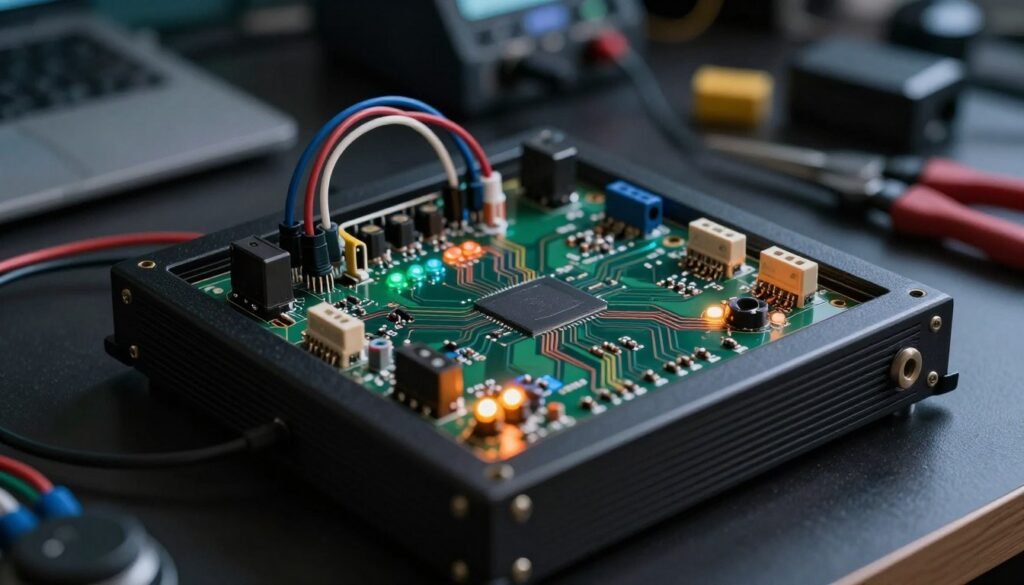
Circuits use an external power source to control a larger output signal. Active components, like transistors, act like a valve. They allow a much larger current to flow from the power supply when a small voltage is applied.
This process keeps the output signal’s shape and frequency the same as the original input. It just makes the magnitude bigger. This is how we process audio and radio waves in modern technology.
What is the difference between voltage and current amplification?
Voltage amplification increases the potential difference, which is key for high-impedance loads. Current amplification increases the flow of charge, needed for low-impedance devices like speakers.
Engineers often use both techniques together. This table shows the main differences between them.
| Merkmal | Voltage Amplification | Current Amplification |
|---|---|---|
| Primary Goal | Increase potential difference | Increase charge flow |
| Typical Load | High impedance | Low impedance |
| Key Application | Sensors and pre-amps | Power stages and speakers |
Mastering signal amplification lets you work with electronic data precisely. Whether it’s a simple radio or a complex system, these principles apply. They help us turn tiny signals into the real-world outputs we use every day.
Integrated Circuits and Microchip Technology
Every digital device has a tiny silicon wafer at its core. This wafer is packed with millions of tiny parts. It’s a marvel of engineering that lets us carry powerful computers in our pockets.
Modern semiconductor technology has changed how we interact with the world. It’s amazing to think about how far we’ve come.
How are millions of components packed onto a single chip?
The journey starts with a thin slice of pure silicon. Engineers use photolithography to project patterns onto the wafer. This light-based method creates paths for electricity in the tiny transistors.
Advanced integrated circuit manufacturing layers materials to build these structures. By repeating these steps, billions of transistors fit on a chip the size of a fingernail. This density enables fast processing in a small space.
What is the significance of Moore’s Law in device evolution?
For decades, the industry has followed Moore’s Law. It says the number of transistors on a chip doubles every two years. This rule has driven rapid integrated circuit manufacturing progress.
Thanks to this growth, our devices get faster, cheaper, and more efficient. While physical limits may soon catch up, Moore’s Law’s legacy inspires new innovations in semiconductor technology. It’s a key milestone in the digital age.
Power Supplies and Energy Management
Power supplies are the heart of your electronic devices, managing energy flow. Most wall outlets give alternating current, but devices like computers or phones need direct current. Energy management systems make sure this change happens well and efficiently.
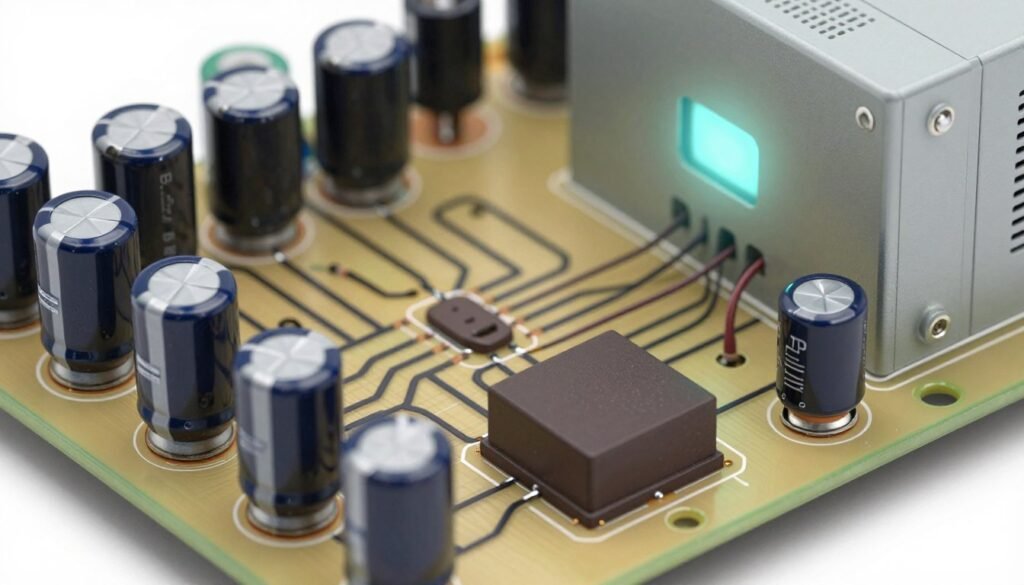
How do rectifiers convert AC to DC power?
The journey starts with power supply rectification, the main job of a rectifier circuit. Diodes in these circuits make sure current flows only one way. This cuts off the negative half of the alternating current wave.
After the first change, the signal is still not smooth. Engineers use capacitors to make it even. This stage is key to stop noise that could mess with internal signals.
Why is voltage regulation critical for sensitive electronics?
Even after the change, power can still vary. Voltage regulation is like a safety net, keeping the output steady. Without it, a sudden power surge could damage the tiny parts inside your processor.
Today’s devices are very precise and need a stable environment to work right. Regulators watch the output and adjust it to keep it steady. This keeps your hardware safe and working well for a long time.
Digital Versus Analog Circuitry
The world of electronics is divided into two main areas: analog and digital. Understanding the difference between these is key to understanding modern technology.
Analog vs digital signals is like comparing a smooth wave to a series of steps. Analog systems mimic nature, while digital systems power our computers.
What defines an analog signal in the real world?
An analog signal is continuous, changing smoothly without breaks. Think of a thermometer or a microphone; they turn physical phenomena into voltage levels.
“Nature is analog, but our machines are increasingly digital, creating a bridge between the physical world and the realm of pure logic.”
These signals are very sensitive to interference. Even a small amount of electrical noise can distort them. That’s why high-fidelity audio equipment needs careful shielding.
How do digital circuits represent information using binary code?
Digital systems use binary logic circuits to process information. They rely on two states: high voltage (1) and low voltage (0).
By combining ones and zeros, computers can store, transmit, and manipulate data accurately. This method is less affected by noise, as it only needs to distinguish between two clear states.
| Merkmal | Analog Signals | Digital Signals |
|---|---|---|
| Signal Type | Continuous | Discrete |
| Representation | Sine Waves | Binary (0 and 1) |
| Noise Sensitivity | Hoch | Niedrig |
| Primary Use | Sensors, Audio | Computing, Data |
The choice between analog and digital depends on the task. While binary logic circuits are key in processors, analog components are crucial for interacting with the physical world.
Troubleshooting Common Circuit Issues
When your project stops working, a systematic approach to diagnostics is your best friend. A reliable circuit troubleshooting guide helps you find problems without damaging your hardware. By following logical steps, you can quickly fix your electronic components.
How can you identify a short circuit safely?
A short circuit happens when current finds an unintended path with very low resistance. To identify this safely, always disconnect the power source before inspecting. Look for signs of damage, like burnt traces, melted insulation, or loose solder bridges.
If the fault is not visible, use a non-contact infrared thermometer to find hot spots on the board. Safety is paramount, so never touch components while the circuit is energized if you suspect a short. Always discharge large capacitors before you begin your investigation to avoid accidental shocks.
What tools are necessary for testing electronic components?
Effective testing requires a few standard pieces of equipment that every hobbyist should own. A high-quality digital multimeter is the most versatile tool for checking voltage, resistance, and continuity. For more advanced tasks, an oscilloscope allows you to visualize signals in real-time.
Using a digital multimeter for basic diagnostics
Mastering multimeter usage is essential for verifying that power reaches your components correctly. Set your device to the continuity mode to check for broken traces or accidental shorts between pins. You can also measure voltage drops across resistors to ensure the circuit behaves as expected.
Interpreting oscilloscope readings for signal analysis
When digital signals or timing issues are involved, oscilloscope signal analysis becomes necessary. This tool displays voltage changes over time, allowing you to see if a signal is distorted or noisy. By observing the waveform, you can identify issues like signal clipping or improper clock frequencies that a standard meter might miss.
Schlussfolgerung
Building a solid foundation in electronics opens doors to endless creative possibilities. You’ve gone from basic passive components to the complex logic in modern microchips.
These core principles are the heartbeat of the devices we use every day. Whether it’s a smartphone from Apple or a high-performance processor from Intel, the same laws apply. Knowing how these parts work lets us see the hidden architecture of our digital world.
Practical experience is the best way to improve your skills. Grab a breadboard, pick up some components, and start building your own circuits. By experimenting with real hardware, abstract theory becomes real knowledge.
Your journey into engineering doesn’t stop here. Keep exploring new schematics and challenging your understanding of how energy flows through silicon. The future of technology needs curious minds ready to innovate and solve complex problems.
FAQ
What is the main difference between active and passive electronic components?
Active components need an outside power source to work. Examples include transistors and integrated circuits. On the other hand, passive components like resistors and capacitors don’t need power. They just manage the energy flowing through the system.
Why is silicon the preferred material for manufacturers like Intel and Nvidia?
Silicon is key because it’s common and has stable electrical properties. Engineers can control its conductivity through doping. This makes it perfect for semiconductors in devices like iPhones and Nvidia graphics cards.
How does a P-N junction function within a standard diode?
A P-N junction is made by combining positive and negative semiconductor materials. It lets current flow in one direction but blocks it in the other. This is why Cree can make efficient LEDs.
What is the significance of Moore’s Law in the evolution of microchips?
Moore’s Law was coined by Intel co-founder Gordon Moore. It says the number of transistors on a chip doubles every two years. This growth has led to faster, more powerful computers.
Why are Field-Effect Transistors (FETs) more common than BJTs in modern processors?
FETs, especially MOSFETs, are better for computing because they use less energy. They can also be made smaller. This lets companies like Samsung make devices that are faster and cooler.
How do rectifiers and voltage regulators work together in a power supply?
Rectifiers change AC from the wall into DC. But the DC can still be unstable. Voltage regulators, often using Zener diodes, keep the output steady. This prevents damage to digital circuits.
What is the role of a Printed Circuit Board (PCB) in modern electronics?
A PCB is the base of a circuit. It has copper tracks on a non-conductive board. These tracks connect components, making sure signals go where they need to without wires.
How does binary code allow digital circuits to process complex information?
Digital circuits use binary code, with ones and zeros, to process information. Billions of transistor switches form logic gates. These gates can do complex math and store data with high precision.
When should I use a digital multimeter versus an oscilloscope for troubleshooting?
Use a digital multimeter for basic checks like voltage and resistance. But for seeing signal changes over time, like checking for interference, use an oscilloscope. Tektronix makes oscilloscopes for this purpose.
Why is thermal management so important for high-performance circuits?
Current flowing through components makes heat. Without proper cooling, like heatsinks or fans, this heat can damage semiconductors. This shortens the device’s life.