
















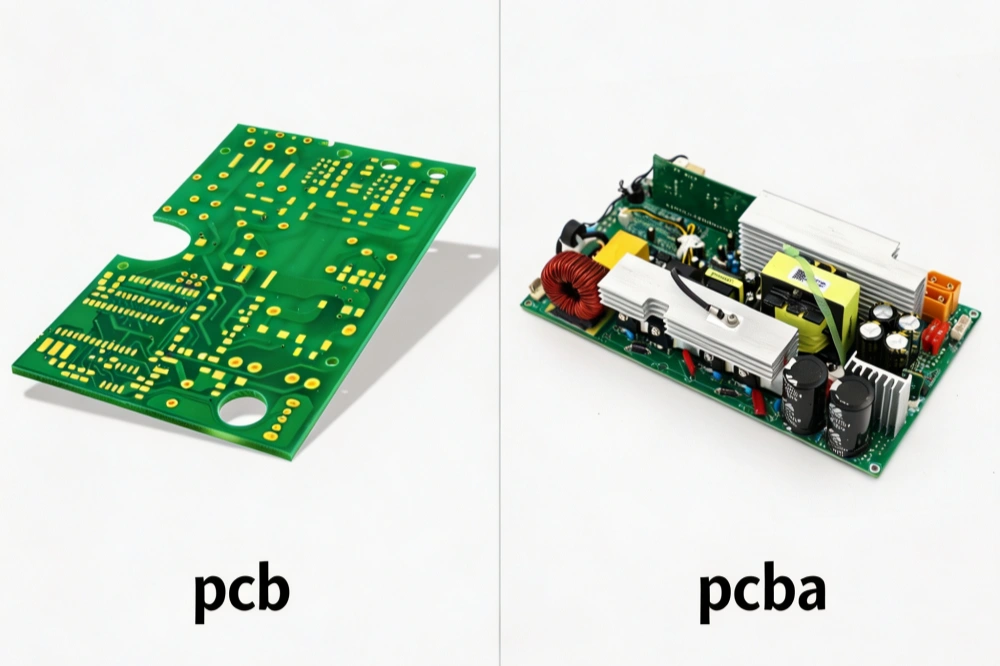
A PCB is a fabricated bare board with copper circuitry but no mounted electronic components. A PCBA is that PCB after components have been placed and electrically joined to it. A PCBA includes a PCB; it is not an alternative type of board. Order PCB fabrication when you need the board itself; order PCB assembly when you need a populated board for inspection, testing, or integration into a product.
The terms are related but not interchangeable. PCB fabrication creates the board. PCB assembly adds the parts and solder joints that turn the board into an electronic assembly. A board becomes a PCBA once components are mounted and joined; inspection and testing normally follow according to the agreed production and quality plan. The PCB vs PCBA decision is therefore about delivery state and manufacturing responsibility, not competing technologies.
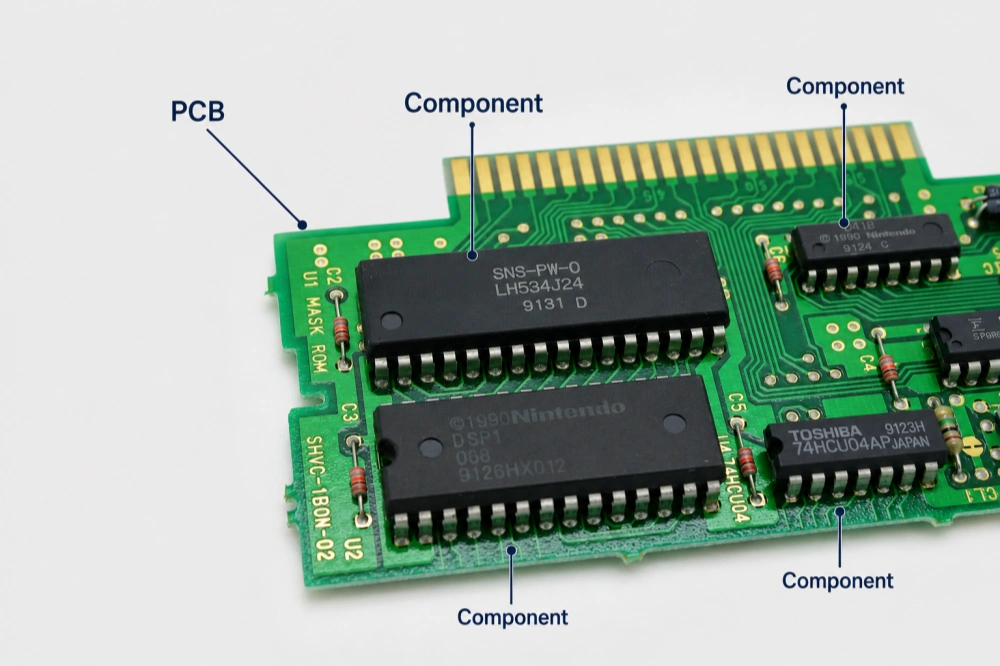
PCB vs. PCBA at a glance
| Question | PCB | PCBA |
|---|---|---|
| Full name | Printed circuit board | Printed circuit board assembly |
| What it is | A bare board that routes electrical connections and supports components | A PCB populated with components and assembly interconnections |
| Typical contents | Laminate, copper features, vias, solder mask, surface finish, and markings as specified | The PCB plus resistors, capacitors, ICs, connectors, and other specified parts |
| Main manufacturing scope | Fabrication of the bare board | Component preparation, placement, and joining; sourcing, bare-board fabrication, inspection, and testing are included only when specified |
| Typical delivery state | Electrically tested bare board, if specified, ready to assemble | Populated board; inspection, test, programming, and system-integration status depend on the agreed scope |
| Main order data | Fabrication files and board specification | Bare-board data plus BOM, placement data, assembly instructions, and test requirements |
What is a PCB?
A PCB is the bare, fabricated platform that mechanically supports components and connects them through patterned conductive features. It is not an operating electronic circuit by itself because the components that provide the circuit’s functions have not yet been attached.
A finished bare PCB can be simple or complex. It may have one or many copper layers, plated holes and vias, solder mask, legend, controlled-impedance features, edge connections, or a selected surface finish. Those features are part of the board fabrication specification. Components such as microcontrollers, LEDs, resistors, and connectors are not part of the PCB until assembly begins.
For rigid boards, the detailed performance requirements are often defined by the purchase order, fabrication drawing, and an invoked specification such as IPC-6012. The exact materials, construction, tolerances, and test requirements still need to be stated for the specific design.
What is a PCBA?
A PCBA is a printed circuit board assembly: a PCB with its specified components installed and electrically connected. The abbreviation describes the assembled board, not just the act of assembling it.
Most PCBAs include soldered surface-mount and/or through-hole parts. Depending on the product and agreed scope, an assembly can also include press-fit parts, connectors, shields, heat sinks, coatings, labels, programming, or other mechanical items. The bill of materials and assembly documentation define what belongs on the finished board.
A PCBA is not automatically a fully tested product. It is already an assembly after its components are fitted and joined. Visual inspection, automated optical inspection, X-ray inspection, in-circuit test, flying-probe test, functional test, and programming are selected only where the design, risk, volume, and customer requirements call for them.
When does a PCB become a PCBA?
A PCB becomes a PCBA when the required components are mounted and electrically joined to the bare board. A functional test may be an important release step, but it is not what changes the name from PCB to PCBA.
The production flow is easiest to understand as a sequence:
PCB design data -> PCB fabrication -> bare PCB -> components -> assembly -> PCBA -> inspection and testing -> system integration
Each arrow represents a handoff that needs clear data and responsibilities. For example, fabrication data tells the board shop what to build; the BOM identifies the components; placement and assembly instructions tell the assembly team how to populate the board; and the test plan defines what must be verified before shipment.
PCB fabrication vs. PCB assembly vs. PCBA manufacturing
PCB fabrication and PCB assembly are separate manufacturing activities. “PCBA manufacturing” is a scope term, not a fixed industry package: an assembly-only quote may start with customer-supplied boards and parts, while a turnkey quote may also include fabrication, component sourcing, and agreed test. Read the scope of work rather than assuming what a label covers.
| Activity | Main purpose | Typical output |
|---|---|---|
| PCB-valmistus | Produces the bare board from manufacturing data | Bare PCB with the specified layers, copper, holes, solder mask, finish, and markings |
| Component sourcing | Obtains the approved parts and manages alternates or shortages where authorized | Components matched to the BOM and purchasing rules |
| PCB-kokoonpano | Places and joins components to the board | Populated board, or PCBA |
| PCBA inspection and test | Verifies workmanship and/or the assembly’s electrical behavior against the agreed plan | Inspection and test records or a defined disposition, where required |
“Turnkey” is also a scope label rather than a fixed package. It commonly means one supplier coordinates bare-board fabrication, component sourcing, assembly, and agreed test. In a consigned or kitted build, the customer supplies specified components and may also supply the bare PCBs. PCBA does not inherently include PCB fabrication, but a PCBA quote can include it when the supplier’s scope says it does.
Many manufacturers can provide both PCB fabrication and assembly. That can reduce handoffs, but it does not eliminate the need to confirm who owns design-for-manufacturing review, component approval, panelization, test fixtures, firmware loading, final test, and delivery criteria.
Philifast — PCB Fabrication & Assembly Services
From bare boards to fully populated PCBAs, we provide one-stop manufacturing with clear scope and quality control.
What happens during PCB assembly?
PCB assembly turns the bare board and approved components into a connected electronic assembly. The exact route depends on the board design and the parts used, but it commonly combines the following steps.
1. Prepare the board, parts, and production data
Before placement begins, the manufacturing team reviews the released data package. The review may cover the board revision, BOM, component availability, alternates, land patterns, assembly side, fiducials, panel format, polarity markings, and test requirements. Component sourcing for PCB assembly is a separate control point: an approved manufacturer part number, substitute policy, and quantity basis matter as much as finding a part with a similar description.
2. Mount surface-mount components
Surface-mount technology (SMT) attaches components to pads on the surface of the PCB. A typical SMT process applies solder paste to pads, places components using position and rotation data, and reflows the assembly so the solder joints form. It is well suited to compact packages and high component density, but the stencil, paste, land pattern, placement data, and reflow profile must suit the actual components. Philifast’s SMT assembly overview provides related terminology and process context.
3. Install through-hole components where required
Through-hole assembly puts component leads through plated holes in the PCB before they are soldered. It remains common for connectors, larger mechanical parts, power components, and designs that use mixed technologies. The joints may be made by wave soldering, selective soldering, or controlled manual soldering, depending on the board and production process. A single PCBA can contain both SMT and through-hole components.
4. Inspect, test, and complete agreed finishing steps
Inspection confirms that the assembly meets the agreed workmanship and placement requirements. Testing is then chosen to address the risks the product needs to control. A netlist-based bare-board electrical test, when specified, can check for opens and shorts in the defined interconnections, but it does not prove that a populated circuit works. A PCBA test plan may use visual inspection, AOI, X-ray for hidden solder joints, in-circuit test, flying-probe test, or functional test. For a fuller overview of these choices, see Philifast’s PCBA testing process and methods.
Where a contract calls up formal workmanship requirements, IPC-A-610 provides acceptability criteria for electronic assemblies, while J-STD-001 covers requirements for soldered electrical and electronic assemblies. The invoked revision, class, acceptance criteria, and any customer-specific requirements should be identified in the quality plan rather than assumed from a generic standard reference.
Do you need PCB fabrication, PCB assembly, or both?
Choose the service based on what you need delivered and where the next manufacturing responsibility sits. The following guide is a practical starting point.
| Your situation | What you likely need | Why |
|---|---|---|
| You will solder and test the board in-house | PCB-valmistus | You need the manufactured bare board, not a populated assembly |
| You already have bare boards and approved components | PCB-kokoonpano | The scope begins with mounting, soldering, inspection, and any agreed test |
| You have a released design but no boards or parts | Turnkey PCB fabrication and PCBA | One scope can coordinate the bare board, parts, and assembly, subject to the quote |
| You are building a prototype with fine-pitch or hard-to-source parts | Assembly planning before ordering boards | Package, availability, land pattern, surface finish, and test access can change the board and assembly plan |
| You are moving a validated design into production | Fabrication plus assembly, with defined inspection and test | The production package must control revisions, approved components, quality criteria, and traceability needs |
The service choice is not permanent. A team may order bare PCBs during early board bring-up, move to kitted PCBA for engineering builds, and later use a turnkey production order. Keeping the fabrication revision, BOM revision, and assembly data aligned is more important than the label used for the order.
What should you provide when ordering PCBA?
A complete PCBA order needs both the bare-board definition and the assembly definition. Sending only Gerber files is usually enough neither to source every component nor to tell an assembler exactly what to place and how to validate it.
| Information to provide | Why it matters |
|---|---|
| Released PCB manufacturing data | Defines layers, drill features, solder mask, surface finish, board outline, and other bare-board requirements |
| Fabrication drawing and stack-up requirements, if applicable | Clarifies material, controlled impedance, copper, tolerances, and special requirements that may not be obvious from artwork alone |
| BOM | Identifies reference designators, quantities, manufacturer part numbers, approved alternates, and do-not-install items |
| Centroid or pick-and-place data | Gives component positions, rotations, sides, and reference designators for placement equipment |
| Assembly drawings and notes | Clarify polarity, orientation, mechanical constraints, hand-assembly steps, and special materials or processes |
| Component sourcing rules | State whether parts are consigned, customer-kitted, or supplier-sourced, and whether substitutes are allowed |
| Panelization, handling, and packaging requirements | Help protect the assembled board and keep it compatible with assembly, depaneling, and delivery needs |
| Test, programming, and acceptance requirements | Define required firmware, fixtures, test coverage, pass/fail criteria, records, and cosmetic or workmanship expectations |
For a more detailed document checklist, see Philifast’s guide to PCBA quote files. Before release, make sure all files refer to the same revision; a correct BOM paired with an older placement file can still produce the wrong PCBA.
Philifast — Complete PCBA Documentation Support
Our team helps you prepare accurate data packages for smooth PCB and PCBA production.
What affects PCBA manufacturing requirements?
Assembly requirements are set by the combination of the board, components, production process, and product-use requirements. The following factors often determine whether a build is simple or needs additional engineering review:
- Component package and pitch: Fine-pitch, bottom-terminated, BGA, and unusual packages can affect land patterns, solder mask, paste printing, inspection access, and rework planning.
- Assembly mix: SMT-only, through-hole-only, and mixed-technology boards require different placement and soldering steps.
- Board construction: Thickness, copper balance, panel design, surface finish, thermal mass, and component clearance can affect handling and soldering.
- Component supply: Obsolescence, allocation, long lead times, and alternative-part approval can change the procurement plan.
- Inspection and test coverage: The right method depends on what defects or functions must be detected, where test points exist, and the production volume.
- End-use requirements: Environmental exposure, traceability, safety, regulatory obligations, and serviceability can introduce additional documentation and process controls.
Discuss these factors before finalizing the board rather than treating assembly as a downstream purchase step. The PCB layout and fabrication specification influence how easily the board can be populated, inspected, tested, and reworked.
Common PCB vs. PCBA misunderstandings
“A PCB is the same thing as a circuit board with parts on it.”
Not in manufacturing language. A PCB usually means the bare printed circuit board. Once components are fitted and connected, it is more precise to call it a PCBA or assembled PCB.
“Every PCBA needs every inspection method.”
No. A suitable quality plan chooses inspection and test methods based on the design and product risk. For example, hidden BGA joints may warrant a different inspection approach from a simple through-hole control board. The required method should be specified, not guessed.
“Component sourcing is separate from PCBA quality.”
It is closely connected. Wrong, unapproved, counterfeit, damaged, or incorrectly revised components can make a correctly fabricated and soldered board unusable. Part approval, traceability requirements, and substitute control belong in the assembly plan.
FAQ
What is the difference between PCB and PCBA?
A PCB is the bare board that contains the conductive paths and mounting features. A PCBA is that board after the specified components have been mounted and electrically connected. PCB fabrication produces the first; PCB assembly produces the second.
When does a PCB become a PCBA?
It becomes a PCBA once the required components are installed and connected to the PCB. Inspection and functional testing are important subsequent steps, but the board does not need to pass a functional test before it is called an assembly.
Does PCBA include PCB manufacturing?
Not by definition. PCBA describes the populated board and the assembly process. A supplier may offer a turnkey scope that includes PCB fabrication and component sourcing, but that must be stated in the quote or purchase order.
What is the difference between PCB manufacturing and PCBA manufacturing?
PCB manufacturing, or fabrication, builds the bare board. PCBA manufacturing describes work to create or deliver populated assemblies. In an assembly-only scope, it may start with supplied boards and components; in a turnkey scope, it may also include fabrication and sourcing. Placement, joining, inspection, test, programming, and finishing are performed as specified.
Do I need PCB fabrication, PCB assembly, or both?
Order fabrication only when you need bare boards for in-house assembly, evaluation, or another assembler. Order assembly when you have the boards and components but need them populated. Order both when you need a supplier to coordinate the bare boards and completed assemblies under a defined scope.
Can one manufacturer provide both PCB and PCBA services?
Yes. Many suppliers offer both, either directly or through coordinated production. Confirm whether the quote includes bare-board fabrication, component sourcing, assembly, test, programming, shipping, and the documentation required for each stage.
What files are required for PCBA manufacturing?
At minimum, expect to provide released bare-board manufacturing data, a BOM, component placement data, and assembly instructions. Add approved alternates, test and programming requirements, panelization details, packaging needs, and any quality or traceability requirements that apply to the product.
Is SMT assembly the same as PCBA?
No. SMT assembly is one method used to build a PCBA by placing components on the board surface and soldering them. A PCBA may use SMT, through-hole assembly, or both.
Philifast — Your PCB & PCBA Partner
From bare boards to tested assemblies, we deliver reliable electronics manufacturing worldwide.