














PHILIFAST, China's Leading PCB & PCBA Manufacturer

We are a professional manufacturer of PCBs and PCBA services. We handle PCB fabrication, SMT assembly, PCBA assembly and testing, component sourcing, firmware programming and flashing, and final product assembly. We focus on giving our customers fast, high-quality PCB and PCBA products.

Our PCB types cover single- and double-sided boards, fiberglass (fr4) boards, multi-layer boards (2 to 38 layers), high-end HDI boards, aluminum-core PCBs, copper-core PCBs, ceramic PCBs, high-frequency (RF) boards, flexible PCBs, and rigid-flex boards. Our products are widely used in communications equipment, medical devices, test and measurement instruments, artificial intelligence, industrial robots, renewable energy and energy storage, automotive electronics, consumer electronics, LED lighting, and industrial equipment. We are a high-tech one-stop electronics manufacturer that works to continuously improve quality, delivery time, and service for our customers.

We operate 7 SMT production lines equipped with the latest Yamaha YRM20 high-speed pick-and-place machines. We also have 2 DIP/through-hole insertion lines, 2 manual soldering lines, an insertion line, wave soldering equipment, and other production tools. For inspection and testing we use advanced equipment such as X-ray, AOI (automatic optical inspection), and SPI (solder paste inspection). These tools let us offer a wide range of PCBA manufacturing services.

Whether you need large-volume production or custom small runs, we can meet your needs. We work efficiently, deliver quickly, and meet delivery schedules.

We always put quality first. We hold certifications including UL, ISO 9001, ISO 14001, and ISO 13485. We follow strict system procedures for production and control. We provide customers with high-quality products, competitive prices, fast lead times, and reliable on-time delivery.

Quality Control Process

We follow a clear quality process from Gerber review to final testing. From fabrication and component inspection to SMT/DIP assembly, IC programming and PCBA testing, every step is checked to ensure reliable boards and on-time delivery.

1
PCB fabrication
We analyze Gerber files before production. Check hole spacing and board strength to avoid bending or breakage.
We analyze Gerber files before production. Check hole spacing and board strength to avoid bending or breakage. Check routing for high-frequency issues and impedance. Make sure the board design meets mounting and electrical needs.
2
Component sourcing & incoming inspection
Buy parts from authorized suppliers only. No used or fake parts.
Buy parts only from authorized distributors and factories. No used or fake parts. Incoming inspection staff check all parts for function and defects. Do not use parts until they pass inspection.
3
SMT assembly
Control solder paste printing and reflow oven. Use AOI to reduce errors.
Solder paste printing and reflow oven control are key. Reflow temperature and speed affect solder wetting and joint reliability. Follow standard SOPs. Use AOI inspection to reduce human errors.
4
DIP / Through-hole assembly
Wave solder tooling and fixtures are critical. Engineers optimize tooling for best results.
Tooling design for wave solder is critical. Proper fixture use gives the best post-reflow results. Process engineers must test and improve tooling and process steps.
5
IC programming (flashing)
Test the PCB first, then choose the proper programming method.
Before programming, test the PCB to make sure it works. Choose the right programming method. We support offline programming and in-circuit programming. Apply code protection if needed.
6
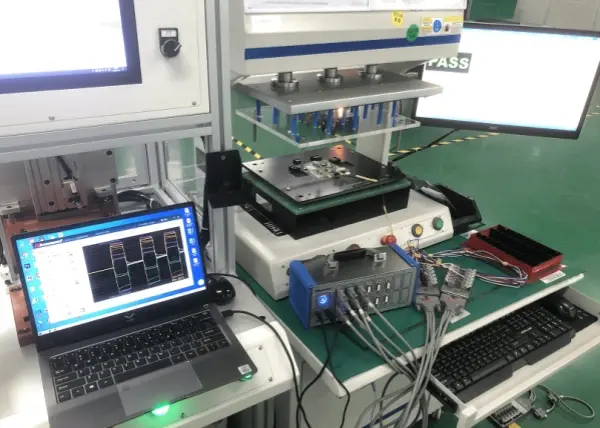
PCBA testing
Run ICT, FCT, aging and environment tests. Record and report all data.
Run ICT (in-circuit test), FCT (functional test), aging test, temperature and humidity test, drop test, and other tests as the customer requests. Record and report all test data.
PCB fabrication

We analyze Gerber files before production. Check hole spacing and board strength to avoid bending or breakage. Check routing for high-frequency issues and impedance. Make sure the board design meets mounting and electrical needs.


Moments Together

Scroll to Top