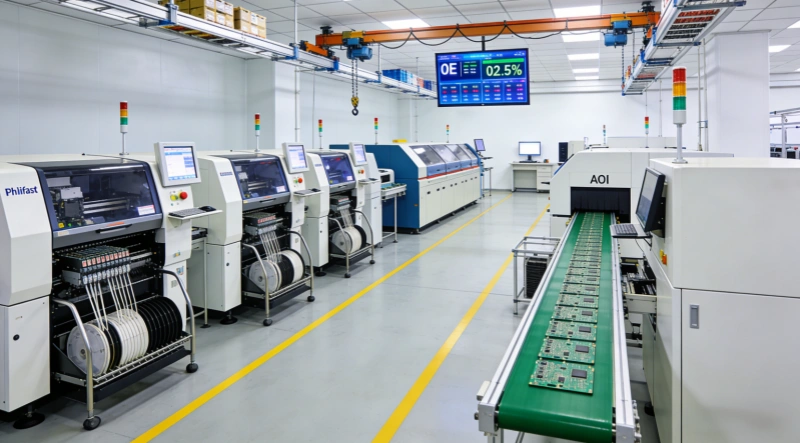

















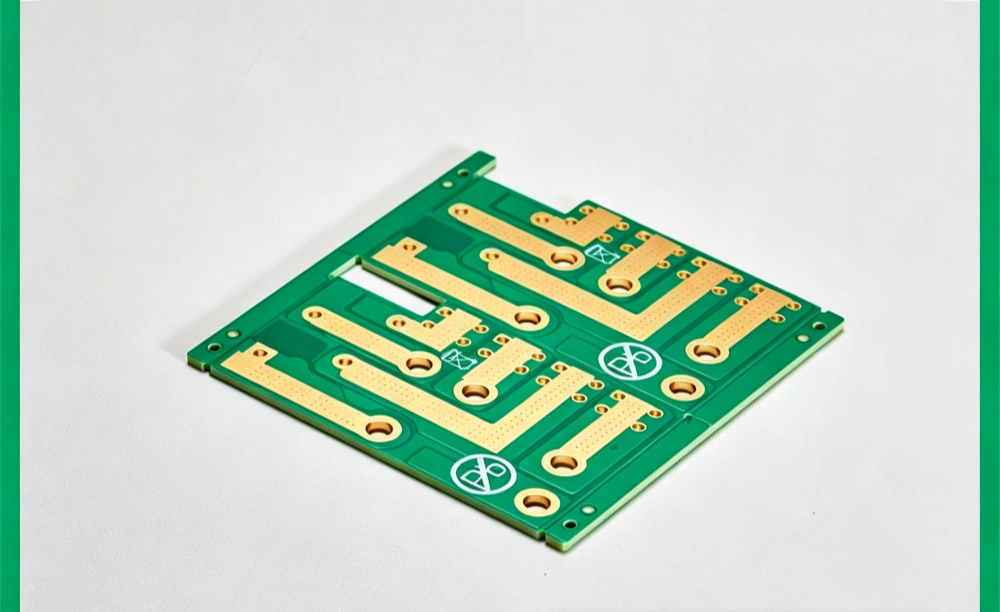
Most PCBs are green because a green solder mask covers their outer copper layers. The solder mask, also called solder resist, is a protective insulating coating applied during PCB manufacturing. It helps prevent unintended solder bridges, protects covered copper, and leaves the copper pads open for soldering. The base board material, commonly FR-4, is usually not what makes a PCB look green.
Green became the most familiar PCB color through long-standing manufacturing practice and its useful visual contrast for people inspecting boards. It is a common default, not a rule of electronics. Red, blue, black, white, yellow, and other solder-mask colors are also available, and the color alone does not determine a board’s electrical, thermal, or mechanical performance.
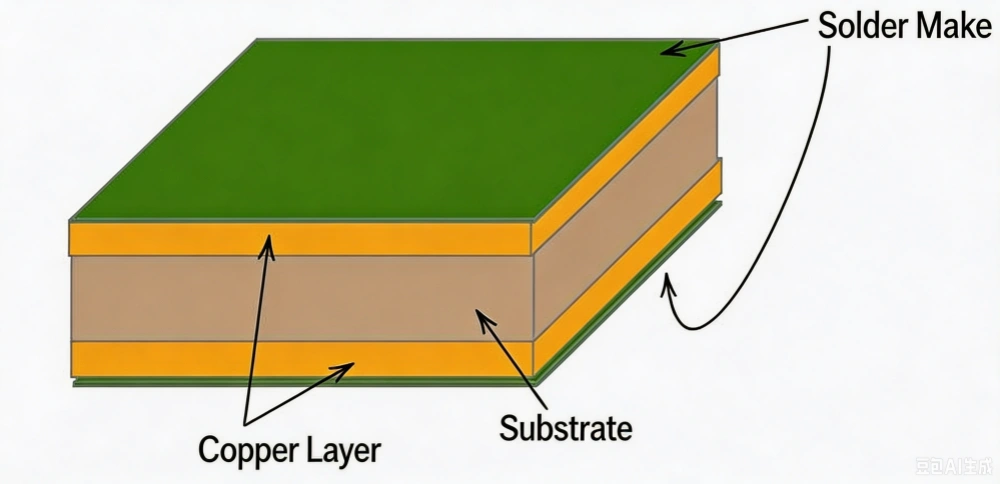
The short answer: a PCB is green because of solder mask
The green layer on a typical board is a polymer coating with colorants, applied over the copper circuitry after imaging and etching. Where the coating is opened around pads, vias, or other specified features, the copper or the selected surface finish remains visible instead.
This distinction matters because a bare laminate and a finished PCB are not the same thing. A board can have a conventional FR-4 core and prepreg yet look green, red, blue, or black after fabrication. Conversely, a non-FR-4 board can also receive green solder mask if its material and process are compatible.
Is the PCB material itself green?
Usually, no. The common rigid-board material called FR-4 is a glass-reinforced epoxy laminate. Its natural appearance varies by material system and viewing conditions; it may look pale yellow, tan, translucent at an edge, or brownish. Copper foil and surface finishes also change what is visible on the board.
| Layer or feature | What it does | What you usually see |
|---|---|---|
| FR-4 laminate | Provides the rigid insulating structure for many PCBs | Often visible only at a routed edge or in an uncoated area |
| Χαλκός | Forms traces, planes, pads, and vias | Mostly hidden under solder mask; exposed at pads and specified openings |
| Solder mask | Insulates and protects selected copper areas | The familiar green, or another selected PCB color |
| Φινίρισμα επιφάνειας | Protects exposed copper pads and supports soldering | Metallic silver, gold, or another finish appearance |
| Μεταξοτυπία | Adds reference designators, polarity marks, logos, and labels | Often white, but not part of the solder mask |
For a fuller explanation of the structural material beneath the coating, see Philifast’s FR-4 PCB material guide. Material selection affects electrical, thermal, and mechanical behavior far more directly than the visible mask color does.
What is solder mask, and what does it do?
Solder mask is a permanent insulating coating that selectively covers the outer copper of a PCB. In normal assembly, it keeps molten solder from spreading across nearby conductors while leaving defined pad areas available for components. It is not the same as the solder itself, the laminate, or the white printed legend.
Depending on the design and manufacturing process, solder mask can help to:
- reduce the risk of solder bridges between closely spaced copper features;
- protect covered copper from handling, contamination, and environmental exposure;
- provide electrical insulation between conductors on the board surface;
- define the exposed land area used for soldering; and
- make traces, pads, and defects easier to see during visual inspection.
Solder mask is part of a controlled fabrication process, not merely paint. The design specifies mask openings and clearances, and the fabricator images, develops, cures, and inspects the coating. Fine-pitch parts, via-in-pad designs, high-voltage clearances, assembly method, and the chosen finish can all affect the appropriate mask design.
Why did green solder mask become so common?
There is no universal standard requiring a PCB to be green, and no single, well-documented event explains its dominance. Green is now a common option because it has long been used in PCB production and can provide practical visual contrast during inspection.
Green gives useful visual contrast
Green mask can provide useful contrast with bright copper, solder, metallic pads, and commonly used white markings. That contrast can help people inspect conductor patterns, pad definition, scratches, residue, and soldering conditions under suitable lighting.
That does not mean green guarantees easier inspection in every situation. Inspection quality also depends on lighting, magnification, camera settings, surface finish, board cleanliness, mask gloss, feature size, and the inspection method. Automated optical inspection is configured for the actual board and process, so color is only one input.
Green is a familiar standard option
Green is a familiar option for board shops, designers, and inspectors. When a product has no visual or process requirement for another color, using a supplier’s standard option can simplify the order. This is a practical explanation for current use, not proof that green is inherently superior or the sole historical reason it became widespread.
It can be the lowest-cost standard option, but not always
At many fabricators, green is the standard option and may be the lowest-cost choice for a particular quote, but it is not automatically cheaper. A nonstandard color may require a different material, handling, setup, or lead time.
Cost is therefore a supplier-specific manufacturing question, not a property of the green pigment itself. Ask the fabricator to quote the selected color with the actual layer count, line width and spacing, mask features, surface finish, quantity, and delivery requirement. Do not assume a color surcharge, or the lack of one, without the quote.
Can PCBs be made in other colors?
Yes. Many PCB manufacturers offer several solder-mask colors, commonly red, blue, black, white, yellow, and green. Availability, minimum features, finish compatibility, appearance, and price vary by fabricator and board technology. A color that is routine for a simple two-layer prototype may need closer process review on a dense HDI or high-reliability board.
The visible color is usually selected for one of three reasons:
- Identification or branding: A product team may want a distinctive internal appearance or a color that matches a product family.
- Assembly and inspection needs: Contrast with markings, components, residues, or mechanical parts may make one color more practical for a specific workflow.
- Application requirements: White mask may be selected where reflectivity matters, such as some LED boards. Other projects use the fabricator’s standard color when no different color is required.
The color selection should be documented in the fabrication data rather than assumed from a rendering.
Are red, blue, black, white, or yellow PCBs different from green PCBs?
They can look different and may require different process controls, but their color alone does not make them electrically faster, cooler, stronger, or more reliable. The important comparison is the full solder-mask system and board specification: material family, cured thickness, adhesion, coverage, cure, insulation performance, flame rating where applicable, design geometry, and compatibility with assembly and cleaning processes.
| PCB color | Common reason to choose it | Practical consideration |
|---|---|---|
| Πράσινο | Familiar standard option and inspection contrast | Confirm whether it is the supplier’s standard option |
| Red or blue | Product identification or visual differentiation | Verify availability and pricing for the required technology |
| Black | A dark, uniform appearance | Surface detail and residue can be harder for people to see under some lighting |
| Λευκό | High-visibility labeling or light-reflective applications | Discoloration, contamination, and contrast requirements deserve attention |
| Yellow | Visual identification or contrast with selected markings | Check available legend colors and inspection contrast |
These are workflow considerations, not universal rules. For example, black mask is not electrically worse than green mask simply because it is black. Yet a team that relies heavily on manual inspection may reasonably prefer a color that makes its particular defects and markings easier to distinguish.
Does PCB color affect electrical, thermal, or mechanical performance?
The visible PCB color by itself has no meaningful direct effect on circuit performance. Electrical performance is driven by the stack-up, copper geometry, dielectric properties, impedance control, surface finish, and layout. Thermal performance is driven mainly by materials, copper distribution, thickness, vias, heat paths, and the cooling system. Mechanical performance depends on the laminate, construction, thickness, copper balance, and environment.
The qualification is important: different colors can come from different solder-mask formulations. If the formulation, thickness, or cure changes, the coating’s own properties can change too. For demanding applications, specify the required mask performance and fabrication requirements rather than treating color as a proxy for quality.
For high-speed boards in particular, material and stack-up decisions should be made around signal and impedance requirements, not PCB color. Philifast’s comparison of FR-4 and high-speed PCB materials explains the decisions that have real signal-integrity consequences.
Philifast — PCB Manufacturing & Assembly
From standard green to custom colors, we provide one-stop PCB and PCBA services worldwide.
Does PCB color affect inspection and manufacturing?
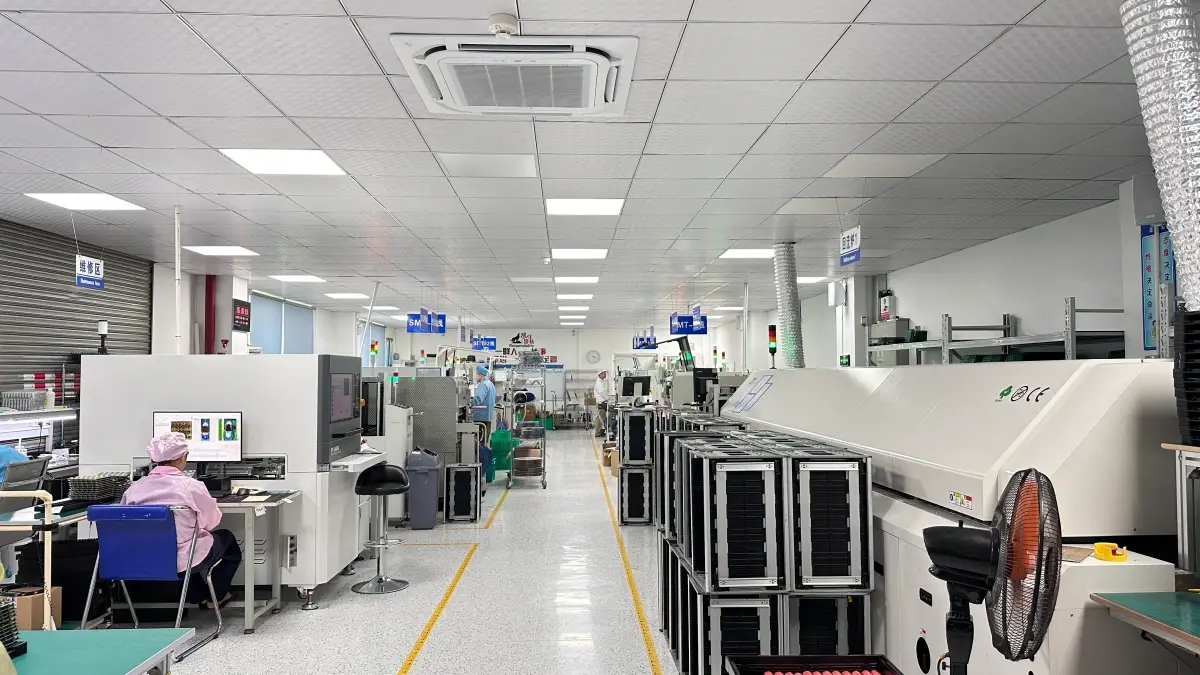
It can affect how easily people and machines see features, but it does not replace process control. A different mask color may change contrast between the board, copper, silkscreen, solder, flux residue, and components, so lighting and inspection settings may need adjustment.
In PCB manufacturing, the key inspection questions are whether the mask is properly registered, covers the intended copper, leaves the intended pads open, has cured correctly, and meets the agreed workmanship criteria. In assembly, solder paste printing, placement accuracy, reflow profile, component polarity, joint quality, and test coverage remain much more important than the mask color.
Choose a color early enough for fabrication review, then qualify the completed board using the same methods intended for production. Philifast’s PCB testing guide provides a useful overview of the inspection and test stages that protect board quality beyond appearance.
How to choose a solder-mask color
For most general-purpose products, choosing the manufacturer’s standard green option is a sensible starting point. Choose another color only when it serves a clear purpose, such as visual identification, contrast, reflectivity, or a documented customer requirement.
Before release, confirm these points with the fabricator:
- Is the requested color available for the board technology, line width and spacing, and surface finish?
- Does it change quoted cost, lead time, minimum order quantity, or minimum solder-mask dam?
- Does the mask system meet the application’s insulation, environmental, and assembly requirements?
- Will the selected color work with the planned silkscreen, optical inspection, and visual acceptance process?
- Are color, gloss, mask openings, and allowable cosmetic variation stated in the fabrication drawing or specification?
If the board will later be assembled, coordinate those details with the assembly requirements rather than selecting the color as a last-minute cosmetic preference.
Philifast — Solder Mask & PCB Finishing
We help you select the right mask color, finish, and process for your product — serving customers globally.
Common misconceptions about green PCBs
“The board is green because FR-4 is green.”
Usually false. A finished green PCB normally gets its appearance from green solder mask over copper, not from the FR-4 laminate underneath. The laminate becomes easier to see at the board edge, in a cutout, or where the outer coating is absent.
“Green boards perform better than other colors.”
False as a general rule. Board performance comes from the complete material set, construction, layout, and manufacturing quality. A particular green mask formulation may be qualified for an application, but the pigment color is not the reason the circuit performs well.
“Other PCB colors are only decorative.”
Not necessarily. A different color can help product identification, visual contrast, or reflectivity. The choice can have practical manufacturing and inspection implications even though it does not directly improve electrical performance.
“A green PCB is always cheaper.”
Not always. Green is frequently a standard option, which can make it economical for a given supplier, but the actual price depends on the supplier’s materials, process, board complexity, quantity, and delivery requirement.
ΣΥΧΝΈΣ ΕΡΩΤΉΣΕΙΣ
Why are PCBs usually green?
PCBs are usually green because green solder mask is a familiar standard option in PCB manufacturing. The coating protects and insulates covered surface copper while leaving solderable pads exposed. Green can also provide useful visual contrast for inspection, although it is not required and other colors are available.
What makes a PCB green?
The green appearance usually comes from pigment in the PCB solder mask, also called solder resist. It is a cured protective coating applied over the outer copper layers. The underlying laminate is a separate structural material and is usually not the source of the finished board’s green color.
What is solder mask made of?
Modern solder masks are commonly polymer-based systems formulated with resins, curing chemistry, pigments, and other additives. Exact chemistry varies by supplier and process. For a controlled product, use the fabricator’s qualified material data and the requirements specified for the board rather than assuming every green mask has the same composition.
Can a PCB be any color?
Not literally any color at every supplier, but many colors are available. Green, red, blue, black, white, and yellow are common options. Confirm color availability, price, minimum feature capability, lead time, and compatibility with the board design and assembly process before release.
Does black solder mask make a PCB hotter?
Not in a way that should drive ordinary electronic thermal design. A surface’s optical absorption and emission can vary with color and finish, but internal PCB temperatures are governed primarily by power dissipation, copper, board materials, component placement, heat paths, and cooling. Analyze those factors for a thermal-critical product.
Is solder mask the same as a surface finish?
No. Solder mask covers selected copper areas around pads and traces. A surface finish protects the exposed copper pads that need to be soldered, such as HASL, ENIG, OSP, immersion tin, or immersion silver. The two serve different functions in the same PCB manufacturing flow.
Philifast — Your PCB Manufacturing Partner
Get expert guidance on solder mask, materials, and assembly for reliable boards worldwide.