

















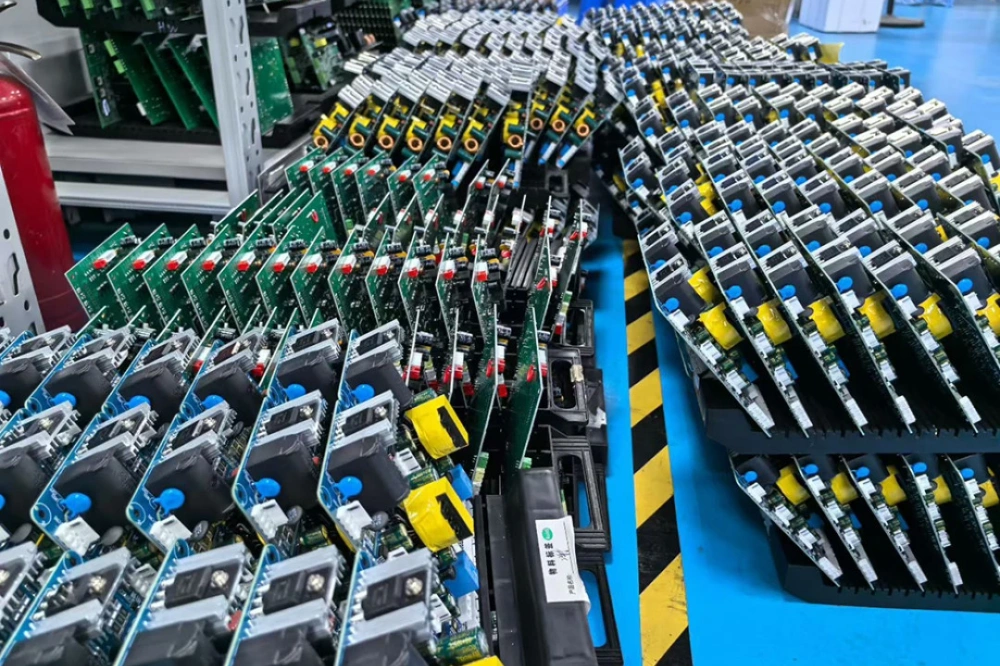
After PCBA is finished, if the finished product assembly does not happen right away, the PCBA must be stored. This prevents the PCBA from being exposed to air for a long time and affecting its performance.
Because there are differences in the PCBA production process and storage conditions, pre-dry the PCB before use (recommended within 24 hours). For chemical immersion tin or immersion silver products, repackage them within 12 hours after unpacking (recommended). If the effective shelf life is exceeded, you can try to dry them after trial use: re-test some performance. If needed, they can still be used after inspection.
The main PCBA storage conditions are:
Applying conformal coating
For PCBA boards not used for a long time, conformal coating should be applied. It protects against moisture, dust, and oxidation. It effectively extends the storage time. After applying conformal coating, storage can be extended by 9 months.
Vacuum packaging
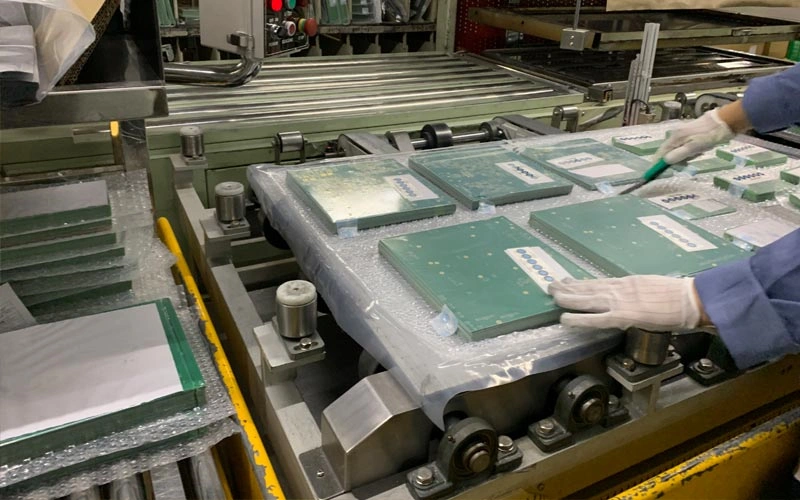
PCBA storage must avoid contact with air and water. First, use vacuum bags to pack the PCBA boards. When boxing, surround the box sides with a layer of bubble film. Bubble film has good water absorption. This helps a lot with moisture protection. Also, desiccant beads are needed. Then sort and place them, and attach labels. After sealing, the box must be kept away from walls, off the ground, in a dry and ventilated place. Avoid sunlight.
Controlling warehouse temperature and humidity
It is best to control the PCBA storage warehouse temperature at 23±3°C and 55±10%RH. Good storage conditions: temperature less than 25°C, relative humidity less than 65%, with temperature control and no corrosive gas in the indoor environment. Under these conditions, PCBA boards with surface finishes like ENIG, electrolytic gold, HASL, and silver plating can usually be stored for 6 months. PCBA boards with surface finishes like immersion silver, immersion tin, and OSP can usually be stored for 3 months.
For PCBs with OSP process, because the protective film is thin, stricter storage conditions are needed for PCBA storage.
Why Expired PCBs Need Baking Before SMT and Reflow Soldering
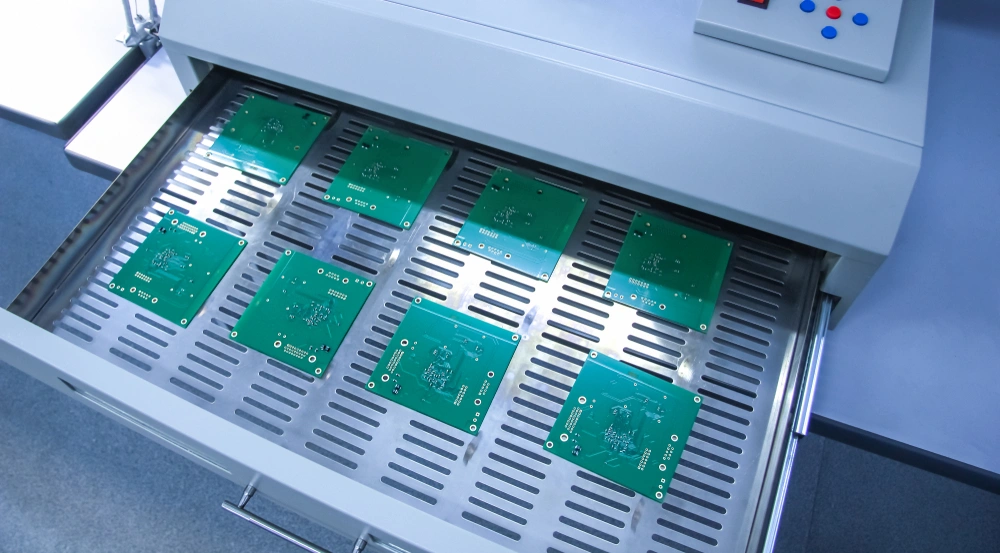
The main purpose of PCB baking is to remove moisture and dampness. It removes water absorbed inside the PCB or from the outside. Some PCB materials easily form water molecules. Also, PCBs may absorb moisture from the environment after being stored for some time. Water is one main cause of PCB blistering or delamination. Water also causes oxidation.
PCB Baking Condition Settings
- If the PCB is within 2 months of its production date and well sealed, and after opening it is placed in a temperature and humidity controlled environment (≤30°C/60%RH, per IPC-1601) for more than 5 days, bake at 120+/-5°C for 1 hour before use.
- If the PCB is stored for more than 2 to 6 months past the production date, bake at 120+/-5°C for 2 hours before use.
- If the PCB is stored for more than 6 to 12 months past the production date, bake at 120+/-5°C for 4 hours before use.
- If the PCB is stored for more than 12 months past the production date, use is basically not recommended. The bonding strength of multilayer boards may age over time. Later there may be quality issues like unstable product function. This increases the market return rate. There are also risks of blistering and poor soldering during production.
All baked PCBs must be used within 5 days. Any unfinished PCB must be re-baked at 120+/-5°C for 1 hour before use.
PCB Baking Method
When baking large-size PCBs, use flat stacking. The recommended maximum number per stack is 30 pieces. Within 10 minutes after baking, open the oven, take out the PCBs, and lay them flat to cool. After baking, press with an anti-warping fixture. Upright baking is not recommended for large-size PCBs, as it easily causes board warping.
When baking medium and small PCBs, flat stacking can be used. The recommended maximum number per stack is 40 pieces. Upright stacking can also be used, with no limit on quantity. Within 10 minutes after baking, open the oven, take out the PCBs, and lay them flat to cool. After baking, press with an anti-warping fixture.
Precautions During PCB Baking
- The baking temperature must not exceed the PCB’s Tg point. Usually it must not exceed 125°C. Some older leaded PCBs had a lower Tg point. Now most lead-free PCBs have a Tg above 150°C.
- Baked PCBs must be used as soon as possible. If not fully used, they should be re-vacuum packed early. If they are exposed in the workshop too long, they must be baked again.
- The oven must have exhaust drying equipment. If not, the evaporated water vapor will stay inside and increase its relative humidity. This is not good for PCB dehumidification.
- From a quality view, the fresher the PCB, the better the quality after soldering. Even if expired PCBs are baked before use, there is still some quality risk.
Baking Condition Judgment
-
When opening an IC bag, check the humidity indicator card. A reading of less than 5% (blue) means normal. More than 5% (pink) means moisture has been absorbed.
Normal packaging (card humidity less than 5%) shows IC is not damp and does not need baking.
Abnormal packaging (card humidity more than 5%) shows IC has absorbed moisture and needs baking.
- After unsealing an IC, if it is stored exposed in an environment with RH more than 60% for more than 72 hours, the IC component must be baked again to remove absorbed moisture.
- For IC components soldered on a PCB that are left exposed at room temperature for more than 120 hours (including rework boards), they need to be baked again.
-
First baking requirements:
★ For situations 1 and 2, baking temperature and time:
a. Oven temperature: 125°C ±5°C
b. IC baking time: 24 hours ±1 hour
c. PCB baking time: 4±1 hour (bake when incoming PCB is over 3 months old)
-
Re-baking conditions:
★ For situation 3, baking temperature and time:
a. Oven temperature: 95°C ±5°C
b. Baking time for IC soldered on PCB: 12 hours ±1 hour.
IC Component Baking Condition Reference Table
| Package Type | Baking Condition (Option 1) | Baking Condition (Option 2) | Applicable Notes |
|---|---|---|---|
| BGA | 120°C ±5°C × 24 hours | 80°C ±5°C × 48 hours | High-density package, high moisture sensitivity |
| QFP / TSOP | 120°C ±5°C × 16 hours | 80°C ±5°C × 24 hours | Medium moisture-sensitive package |
| TQFP | 120°C ±5°C × 12 hours | 80°C ±5°C × 20 hours | Thinner package, lower moisture absorption |
| TRANSFORMER | 120°C ±5°C × 12 hours | 80°C ±5°C × 20 hours | Non-IC but needs moisture-proof treatment |
| Other IC | 120°C ±5°C × 12 hours | 80°C ±5°C × 20 hours | General standard reference |
Disadvantages of PCB Baking
Baking speeds up oxidation of the PCB surface plating. A higher temperature and longer baking time are worse.
High-temperature baking is not recommended for boards with OSP surface finish. The OSP film can degrade or fail because of high temperature. If baking must be done, use a temperature of 105+/-5°C. It is best not to exceed 2 hours. After baking, use the boards within 24 hours.

