
















¿Sabías que un smartphone normal tiene más de dos mil millones de transistores minúsculos? Estas piezas diminutas son fundamentales para nuestro mundo digital. Sin embargo, a menudo nos parecen algo mágico.
Adentrémonos en el mundo de dispositivos y circuitos electrónicos. Nuestro objetivo es hacer que estos temas complejos resulten fáciles de entender. Verás cómo la electricidad lo mueve todo, desde tu cafetera hasta el equipo espacial.
Aprender estos temas técnicos no tiene por qué ser difícil. Utilizamos explicaciones sencillas para todos. Al final, comprenderás la tecnología que da forma a tu vida.
Principales conclusiones
- Los transistores son los componentes básicos de la tecnología moderna.
- El funcionamiento básico nos ayuda a comprender cómo funcionan los dispositivos.
- Los sistemas complejos se basan en patrones sencillos.
- Aprender estos principios te ayuda a comprender las nuevas tecnologías.
- Utilizamos un lenguaje sencillo para ayudarte a alcanzar el éxito.
Fundamentos de los dispositivos y circuitos electrónicos
La esencia de la tecnología moderna reside en el control del movimiento de los electrones. Para comprender cómo funciona nuestro mundo digital, debemos entender los fundamentos de dispositivos y circuitos electrónicos. Estos elementos son fundamentales para que los ingenieros puedan gestionar la energía y la información.
¿Qué es exactamente un dispositivo electrónico?
Un dispositivo electrónico controla el flujo de electrones para una tarea concreta. Pueden ser activos o pasivos. Dispositivos activos, al igual que los transistores, pueden amplificar señales o actuar como interruptores.
Los elementos pasivos, como las resistencias y los condensadores, funcionan sin una fuente de alimentación externa. Conocer estos Fundamentos de ingeniería electrónica es fundamental para el desarrollo de hardware. Al combinar estos componentes, creamos sistemas para el procesamiento de datos complejos.
¿En qué se diferencian los circuitos de los simples recorridos eléctricos?
Un circuito eléctrico simple es simplemente un bucle por el que circula la corriente, como una pila que enciende una bombilla. Sin embargo, un circuito es un sistema complejo destinado al procesamiento de señales o a la gestión de la energía. Aprendizaje Conceptos básicos del diseño de circuitos es fundamental para crear tecnología funcional.
La siguiente tabla muestra las principales diferencias entre los componentes utilizados en los diseños modernos:
| Tipo de componente | Función principal | Ejemplo |
|---|---|---|
| Dispositivo activo | Controla el flujo de corriente | Transistor |
| Componente pasivo | Limita o almacena energía | Resistencia |
| Circuito integrado | Procesamiento lógico complejo | Microchip |
Al combinar estos elementos, creamos vías para la lógica, la memoria y la comunicación a larga distancia. Comprender cómo funcionan estas piezas es el primer paso hacia la innovación en el campo de la electrónica.
Comprensión de los componentes pasivos en los circuitos modernos
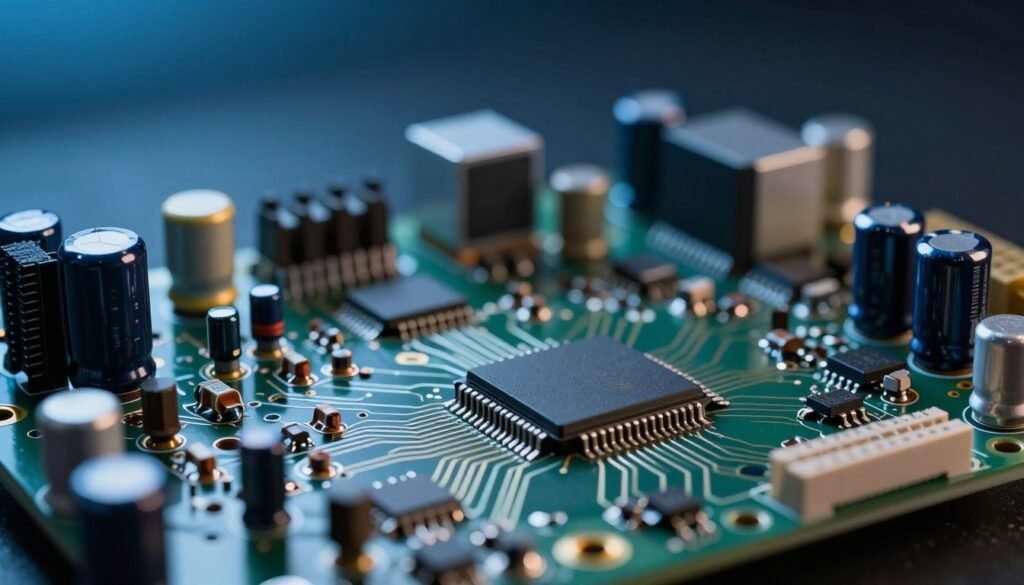
Cada placa de circuito está repleta de componentes electrónicos que gestionan la electricidad de forma silenciosa. Estos dispositivos no necesitan una fuente de alimentación externa para funcionar. En su lugar, utilizan la energía del circuito para moldear, almacenar o limitar las señales eléctricas.
Estos componentes electrónicos pasivos ayudan a los ingenieros a crear sistemas estables y fiables. Sin ellos, nuestros dispositivos modernos no funcionarían. Se encargan de mantener el delicado equilibrio entre el voltaje y la corriente necesario para su funcionamiento.
¿Por qué son imprescindibles las resistencias para el control de la corriente?
Las resistencias actúan como los guardianes de un circuito. Su función principal es limitar la intensidad de la corriente hasta un nivel seguro. Esto evita que las piezas sensibles se quemen.
Piensa en las resistencias como una válvula en una tubería de agua. Limitan el caudal para mantener la presión a un nivel controlable. Esto permite que los demás componentes funcionen en sus condiciones óptimas.
Las resistencias son fundamentales para crear divisores de tensión. Garantizan que las señales se mantengan nítidas y precisas en todo el sistema.
¿Cómo almacenan y liberan energía los condensadores?
Los condensadores actúan como pequeños depósitos de energía temporales. Almacenan carga eléctrica en un campo eléctrico y la liberan cuando es necesario. Esto los convierte en increíblemente útil para suavizar las fluctuaciones de tensión.
Es habitual encontrarlos en las fuentes de alimentación. Ayudan a mantener una salida estable. Al absorber los picos de tensión y compensar las caídas, garantizan que los dispositivos reciban un flujo de energía limpio y constante.
¿Qué función desempeñan los inductores en el almacenamiento de campos magnéticos?
Los inductores almacenan energía en un campo magnético, en lugar de en uno eléctrico. Cuando la corriente circula por una bobina de alambre, genera un efecto magnético. Este efecto se opone a los cambios en la corriente.
Esta propiedad es fundamental para el filtrado filtran el ruido no deseado y las señales de sincronización en sistemas electrónicos complejos. Son los socios silenciosos en los circuitos de radiofrecuencia y en las tareas de conversión de energía. Al gestionar la energía magnética, contribuyen a mantener la precisión y la eficiencia de las señales.
| Componente | Función principal | Tipo de almacenamiento de energía |
|---|---|---|
| Resistencia | Limita el flujo de corriente | Ninguna (se disipa en forma de calor) |
| Condensador | Almacena carga eléctrica | Campo eléctrico |
| Inductor | Se resiste al cambio actual | Campo magnético |
El papel de los semiconductores en la electrónica
Los semiconductores son fundamentales en nuestro mundo digital. Pueden actuar tanto como conductores como aislantes. Esto los convierte en elementos cruciales para tecnología de semiconductores en los dispositivos actuales.
¿Por qué el silicio es la columna vertebral de la industria?
El silicio se utiliza ampliamente en la electrónica por buenas razones. Es un material abundante, que se encuentra en la arena, lo que hace que su producción sea barata. Su propiedades de los semiconductores de silicio además, ayudan a proteger los circuitos con una capa de óxido estable.
“El chip de silicio es el invento más importante del siglo XX, ya que actúa como el cerebro de todo, desde las tostadoras hasta las naves espaciales”.”
Los ingenieros eligen el silicio por su resistencia a altas temperaturas. Esto garantiza el buen funcionamiento de los dispositivos, incluso en condiciones adversas. A continuación explicamos por qué el silicio es la mejor opción frente a otros materiales.
| Característica | Silicio | germanio | Arseniuro de galio |
|---|---|---|---|
| Abundancia | Muy alta | Bajo | Moderado |
| Estabilidad térmica | Excelente | Pobre | Bien |
| Coste | Bajo | Alta | Muy alta |
¿Cómo influye la dopaje en el comportamiento de los semiconductores?
El silicio puro no es un buen conductor de la electricidad. El dopaje cambia esta situación mediante la adición de pequeñas cantidades de impurezas. Esto modifica considerablemente propiedades de los semiconductores de silicio para un mejor control eléctrico.
El dopaje da lugar a dos tipos principales de materiales:
- Tipo N: Añade electrones adicionales.
- Tipo P: Crea “huecos” donde faltan electrones.
La combinación de estos tipos es fundamental para tecnología de semiconductores. Nos permite fabricar interruptores y amplificadores para todo tipo de dispositivos, desde simples calculadoras hasta sistemas de inteligencia artificial.
Los diodos y sus aplicaciones prácticas
Los diodos son fundamentales en cualquier circuito electrónico. Actúan como válvulas unidireccionales para la corriente. Esto significa que permiten que la electricidad fluya en una sola dirección, protegiendo los componentes sensibles y convirtiendo las señales.
These components are simple yet crucial. You’ll find them in everything from smartphones to big industrial power grids.
How does a P-N junction allow current to flow in one direction?
The magic happens in P-N junction physics. When a P-type semiconductor meets an N-type material, a special region forms. This region blocks charge carriers from crossing over.
Apply a positive voltage to the P-side, and the barrier shrinks. This lets current flow freely. But reverse the voltage, and the barrier grows, blocking current. This unidirectional flow is why diodes protect circuits.
- Prevents reverse polarity damage.
- Converts alternating current (AC) to direct current (DC).
- Isolates different sections of a circuit.
What are the common uses for Zener diodes in power supplies?
Zener diodes are special. They work in the reverse breakdown region. They’re increíblemente útil for keeping voltage levels steady, even when power changes.
They’re essential in power supply design for stable performance. Engineers use them to protect electronics from voltage spikes. By setting a voltage threshold, they keep surges away from sensitive microchips.
The following table shows common diode types in modern electronics:
| Diode Type | Función principal | Typical Application |
|---|---|---|
| Rectifier Diode | AC to DC conversion | Power adapters |
| Zener Diode | Voltage regulation | Voltage reference circuits |
| LED | Light emission | Status indicators |
Learning about these components is key to mastering electronics. Whether you’re working on a hobby project or studying complex systems, understanding P-N junction physics is essential.
Transistors as the Building Blocks of Computing
The story of computing is about making electronic switches smaller. These tiny parts are key to modern computing hardware. They help make everything from simple calculators to advanced AI systems.
How does a Bipolar Junction Transistor (BJT) function as a switch?
A Bipolar Junction Transistor, or BJT, controls electricity flow. It uses a small input current to manage a larger current. This lets it switch between zero and one, the basis of digital logic.
When the base current is on, the switch is open, letting power through. Turn off the current, and the circuit closes, stopping power flow.
Why are Field-Effect Transistors (FETs) preferred in modern processors?
Field-Effect Transistors (FETs) are now the top choice for modern computing hardware. Unlike BJTs, FETs need almost no current to stay in their state. This is crucial for keeping billions of transistors cool in a tiny chip.
FETs are so small that engineers can fit millions on one chip. This density boosts device speed. Their fast transistor switching is key for today’s quick calculations.
| Característica | Bipolar Junction Transistor (BJT) | Field-Effect Transistor (FET) |
|---|---|---|
| Control Method | Current-controlled | Voltage-controlled |
| Power Consumption | Más alto | Very Low |
| Primary Use | Amplification | Digital Logic/Processors |
| Talla | Larger | Extremely Small |
Amplification and Signal Processing Basics
Electronic signals start as tiny, fragile pulses. They need a boost to become useful. Without signal amplification, the information carried by these signals would be lost. Understanding these concepts is key to Conceptos básicos del diseño de circuitos.
How do circuits increase the strength of a weak signal?
Circuits use an external power source to control a larger output signal. Active components, like transistors, act like a valve. They allow a much larger current to flow from the power supply when a small voltage is applied.
This process keeps the output signal’s shape and frequency the same as the original input. It just makes the magnitude bigger. This is how we process audio and radio waves in modern technology.
What is the difference between voltage and current amplification?
Voltage amplification increases the potential difference, which is key for high-impedance loads. Current amplification increases the flow of charge, needed for low-impedance devices like speakers.
Engineers often use both techniques together. This table shows the main differences between them.
| Característica | Voltage Amplification | Current Amplification |
|---|---|---|
| Primary Goal | Increase potential difference | Increase charge flow |
| Typical Load | High impedance | Low impedance |
| Key Application | Sensors and pre-amps | Power stages and speakers |
Mastering signal amplification lets you work with electronic data precisely. Whether it’s a simple radio or a complex system, these principles apply. They help us turn tiny signals into the real-world outputs we use every day.
Integrated Circuits and Microchip Technology
Every digital device has a tiny silicon wafer at its core. This wafer is packed with millions of tiny parts. It’s a marvel of engineering that lets us carry powerful computers in our pockets.
Modern tecnología de semiconductores has changed how we interact with the world. It’s amazing to think about how far we’ve come.
How are millions of components packed onto a single chip?
The journey starts with a thin slice of pure silicon. Engineers use photolithography to project patterns onto the wafer. This light-based method creates paths for electricity in the tiny transistors.
Advanced integrated circuit manufacturing layers materials to build these structures. By repeating these steps, billions of transistors fit on a chip the size of a fingernail. This density enables fast processing in a small space.
What is the significance of Moore’s Law in device evolution?
For decades, the industry has followed Moore’s Law. It says the number of transistors on a chip doubles every two years. This rule has driven rapid integrated circuit manufacturing progress.
Thanks to this growth, our devices get faster, cheaper, and more efficient. While physical limits may soon catch up, Moore’s Law’s legacy inspires new innovations in tecnología de semiconductores. It’s a key milestone in the digital age.
Power Supplies and Energy Management
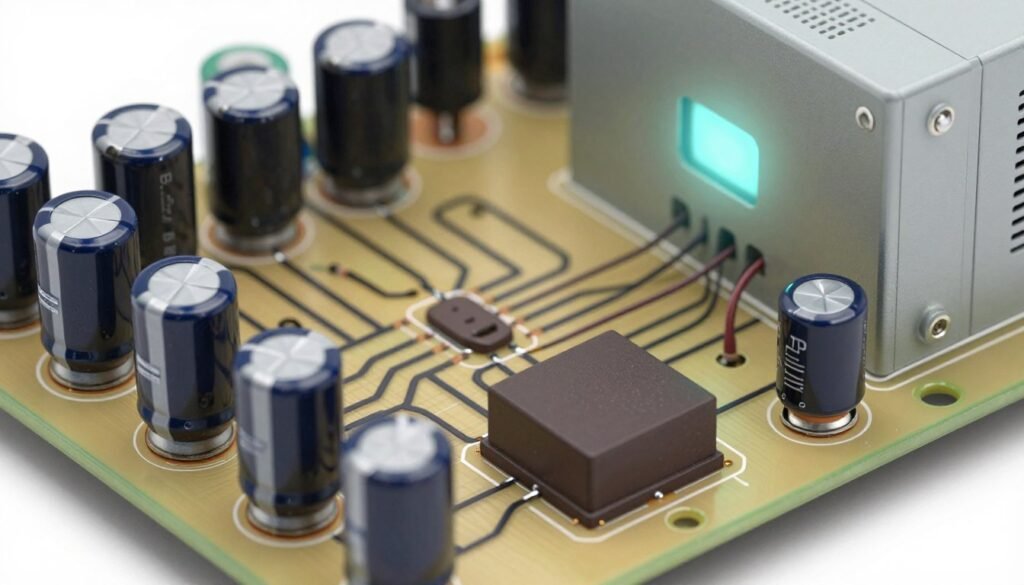
Power supplies are the heart of your electronic devices, managing energy flow. Most wall outlets give alternating current, but devices like computers or phones need direct current. Energy management systems make sure this change happens well and efficiently.
How do rectifiers convert AC to DC power?
The journey starts with power supply rectification, the main job of a rectifier circuit. Diodes in these circuits make sure current flows only one way. This cuts off the negative half of the alternating current wave.
After the first change, the signal is still not smooth. Engineers use capacitors to make it even. This stage is key to stop noise that could mess with internal signals.
Why is voltage regulation critical for sensitive electronics?
Even after the change, power can still vary. Voltage regulation is like a safety net, keeping the output steady. Without it, a sudden power surge could damage the tiny parts inside your processor.
Today’s devices are very precise and need a stable environment to work right. Regulators watch the output and adjust it to keep it steady. This keeps your hardware safe and working well for a long time.
Digital Versus Analog Circuitry
The world of electronics is divided into two main areas: analog and digital. Understanding the difference between these is key to understanding modern technology.
Analog vs digital signals is like comparing a smooth wave to a series of steps. Analog systems mimic nature, while digital systems power our computers.
What defines an analog signal in the real world?
An analog signal is continuous, changing smoothly without breaks. Think of a thermometer or a microphone; they turn physical phenomena into voltage levels.
“Nature is analog, but our machines are increasingly digital, creating a bridge between the physical world and the realm of pure logic.”
These signals are very sensitive to interference. Even a small amount of electrical noise can distort them. That’s why high-fidelity audio equipment needs careful shielding.
How do digital circuits represent information using binary code?
Digital systems use binary logic circuits to process information. They rely on two states: high voltage (1) and low voltage (0).
By combining ones and zeros, computers can store, transmit, and manipulate data accurately. This method is less affected by noise, as it only needs to distinguish between two clear states.
| Característica | Analog Signals | Digital Signals |
|---|---|---|
| Signal Type | Continuous | Discrete |
| Representation | Sine Waves | Binary (0 and 1) |
| Noise Sensitivity | Alta | Bajo |
| Primary Use | Sensors, Audio | Computing, Data |
The choice between analog and digital depends on the task. While binary logic circuits are key in processors, analog components are crucial for interacting with the physical world.
Troubleshooting Common Circuit Issues
When your project stops working, a systematic approach to diagnostics is your best friend. A reliable circuit troubleshooting guide helps you find problems without damaging your hardware. By following logical steps, you can quickly fix your componentes electrónicos.
How can you identify a short circuit safely?
A short circuit happens when current finds an unintended path with very low resistance. To identify this safely, always disconnect the power source before inspecting. Look for signs of damage, like burnt traces, melted insulation, or loose solder bridges.
If the fault is not visible, use a non-contact infrared thermometer to find hot spots on the board. Safety is paramount, so never touch components while the circuit is energized if you suspect a short. Always discharge large capacitors before you begin your investigation to avoid accidental shocks.
What tools are necessary for testing electronic components?
Effective testing requires a few standard pieces of equipment that every hobbyist should own. A high-quality digital multimeter is the most versatile tool for checking voltage, resistance, and continuity. For more advanced tasks, an oscilloscope allows you to visualize signals in real-time.
Using a digital multimeter for basic diagnostics
Mastering multimeter usage is essential for verifying that power reaches your components correctly. Set your device to the continuity mode to check for broken traces or accidental shorts between pins. You can also measure voltage drops across resistors to ensure the circuit behaves as expected.
Interpreting oscilloscope readings for signal analysis
When digital signals or timing issues are involved, oscilloscope signal analysis becomes necessary. This tool displays voltage changes over time, allowing you to see if a signal is distorted or noisy. By observing the waveform, you can identify issues like signal clipping or improper clock frequencies that a standard meter might miss.
Conclusión
Building a solid foundation in electronics opens doors to endless creative possibilities. You’ve gone from basic passive components to the complex logic in modern microchips.
These core principles are the heartbeat of the devices we use every day. Whether it’s a smartphone from Apple or a high-performance processor from Intel, the same laws apply. Knowing how these parts work lets us see the hidden architecture of our digital world.
Practical experience is the best way to improve your skills. Grab a breadboard, pick up some components, and start building your own circuits. By experimenting with real hardware, abstract theory becomes real knowledge.
Your journey into engineering doesn’t stop here. Keep exploring new schematics and challenging your understanding of how energy flows through silicon. The future of technology needs curious minds ready to innovate and solve complex problems.
PREGUNTAS FRECUENTES
What is the main difference between active and passive electronic components?
Active components need an outside power source to work. Examples include transistors and integrated circuits. On the other hand, passive components like resistors and capacitors don’t need power. They just manage the energy flowing through the system.
Why is silicon the preferred material for manufacturers like Intel and Nvidia?
Silicon is key because it’s common and has stable electrical properties. Engineers can control its conductivity through doping. This makes it perfect for semiconductors in devices like iPhones and Nvidia graphics cards.
How does a P-N junction function within a standard diode?
A P-N junction is made by combining positive and negative semiconductor materials. It lets current flow in one direction but blocks it in the other. This is why Cree can make efficient LEDs.
What is the significance of Moore’s Law in the evolution of microchips?
Moore’s Law was coined by Intel co-founder Gordon Moore. It says the number of transistors on a chip doubles every two years. This growth has led to faster, more powerful computers.
Why are Field-Effect Transistors (FETs) more common than BJTs in modern processors?
FETs, especially MOSFETs, are better for computing because they use less energy. They can also be made smaller. This lets companies like Samsung make devices that are faster and cooler.
How do rectifiers and voltage regulators work together in a power supply?
Rectifiers change AC from the wall into DC. But the DC can still be unstable. Voltage regulators, often using Zener diodes, keep the output steady. This prevents damage to digital circuits.
What is the role of a Printed Circuit Board (PCB) in modern electronics?
A PCB is the base of a circuit. It has copper tracks on a non-conductive board. These tracks connect components, making sure signals go where they need to without wires.
How does binary code allow digital circuits to process complex information?
Digital circuits use binary code, with ones and zeros, to process information. Billions of transistor switches form logic gates. These gates can do complex math and store data with high precision.
When should I use a digital multimeter versus an oscilloscope for troubleshooting?
Use a digital multimeter for basic checks like voltage and resistance. But for seeing signal changes over time, like checking for interference, use an oscilloscope. Tektronix makes oscilloscopes for this purpose.
Why is thermal management so important for high-performance circuits?
Current flowing through components makes heat. Without proper cooling, like heatsinks or fans, this heat can damage semiconductors. This shortens the device’s life.