
















When we take on a project that is outside our comfort zone, we have all been there at one time or another. For me, that day came when my boss asked me to design a high-speed board. Even though I thought I was an experienced circuit designer, I knew that high-speed PCB design had many limits that you do not usually face when you design an average circuit. At first, I spent time making the schematic fit for high-speed design. But once that was done, I focused fully on whether my high-speed PCB prototype should use FR-4 or a more specialized material. Before we look at what I learned, it is important to know that in this article, “high-speed” means anything above 50 MHz. These are the material points you should pay attention to when working in this frequency range.
High-speed design has stricter rules for signal integrity than other designs. Even though you must be very careful with routing high-speed signals to meet these rules, it is important to understand that the board material itself is part of the full signal integrity equation. Because of this, board materials used in high-speed design need properties such as a tightly controlled dielectric constant to help control impedance. If impedance is allowed to change across the design, high-speed signals will start to reflect energy back as they move through the traces, and the signal will become distorted. In the same way, a low dissipation factor is needed to help keep signal integrity. Finally, thermal stability is another important property, because it helps make sure the dielectric performance does not break down.
FR-4: Advantages and Disadvantages
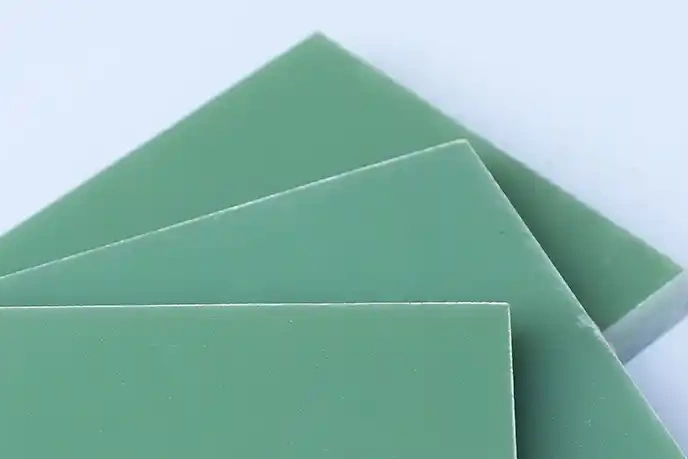
Since I have been designing printed circuit boards, FR-4 has always been the standard material for PCB production. Back when I was still a junior designer, we even used to call all boards “FR-4,” no matter whether they were actually made from it or not. FR-4 is a flame-retardant type 4 glass fiber reinforced epoxy laminate. It is a very cost-effective material. It is also a very good electrical insulator and is very strong in both dry and humid conditions. It also has good fabrication performance, which makes it a very good material for building PCBs.
The downside of FR-4 is that it has limits when power, voltage, or heat become too high. If it is pushed past its working limits, the dielectric performance of FR-4 will drop. This means the insulation ability of the material will get worse, and it will begin to conduct electricity. Another issue with FR-4 is keeping stable impedance in high-speed design. This is because the dielectric constant of FR-4 can change across the length and width of the board. Also, as design speed increases, signal loss that may be acceptable in non-high-speed designs can become too high on FR-4 boards.
Specialized High-Speed Board Materials vs. FR-4
Special high-speed board materials, such as thermoset hydrocarbon and PTFE laminates, can give better and more reliable performance than FR-4 in designs with higher frequencies. We will look at the trade-offs later, but first let us look at some of the benefits these high-speed board materials can offer:
- Less signal loss. As transmission line frequency goes up, signal loss becomes a bigger problem. High-speed design board materials have a much lower dissipation factor than FR-4, and some materials, such as near-pure PTFE laminates, are better by an order of magnitude. These lower dissipation factors are an important part of reducing signal loss.
- Mayor control de la impedancia. Traditional PCB materials, such as FR-4, cannot control dielectric constant (Dk) as well as high-speed board materials. FR-4 Dk can vary by +/- 10% or more, while materials such as PTFE keep Dk tolerance at +/- 2% or better.
- Mejor gestión térmica. Some high-speed design board materials, such as thermoset hydrocarbon laminates, have much better thermal conductivity than FR-4. If your design has thermal management concerns, these are the board materials worth looking at.
- Lower moisture absorption. Water has dielectric properties, and even a small amount of moisture absorbed into a PCB with high-frequency circuits can change the electrical performance of those circuits. While FR-4 has a moisture absorption rate close to 50%, some PTFE materials have a rate as low as 2%, so this issue should be considered.
- Better dimensional stability. For dense high-speed designs with tight tolerances, the need for dimensional stability becomes even more important. Although FR-4 is known for its dimensional stability, it does not offer the other benefits that high-speed materials provide. In this case, thermoset hydrocarbon laminates may be the better choice.