













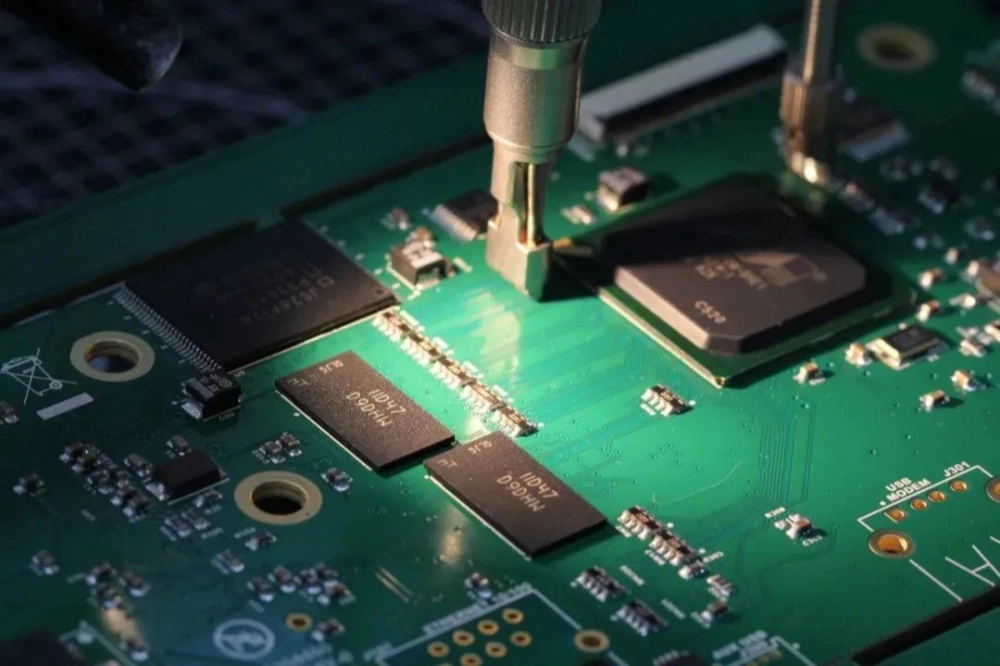
Neither ENIG nor HASL is universally better. ENIG is usually the stronger choice when a design needs a very flat soldering surface, such as fine-pitch SMT or small-pitch BGA and QFN pads. HASL is often the more economical choice for designs with less demanding coplanarity requirements and can provide good solderability when specified and processed correctly.
The decision should follow the component package, assembly process, compliance requirements, storage and handling plan, and the fabricator’s qualified process. Surface finish protects exposed copper pads and supports soldering; it does not replace sound pad design, a controlled assembly profile, or incoming-board inspection.
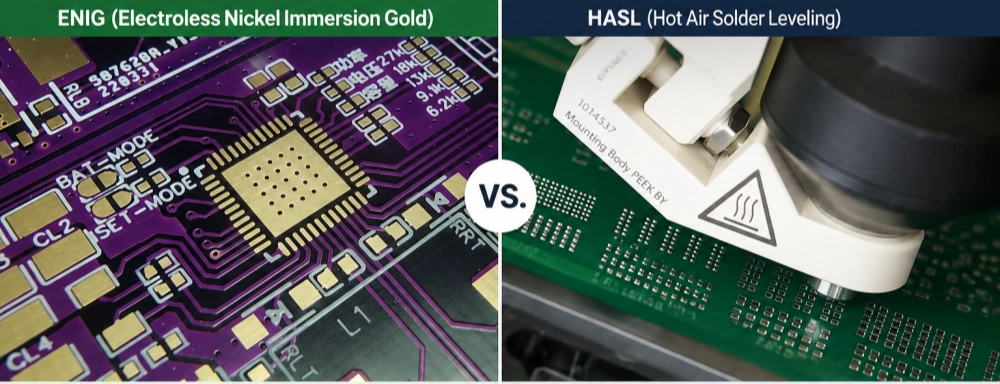
ENIG vs. HASL at a glance
| Factor | ENIG | HASL / lead-free HASL |
|---|---|---|
| Full name | Electroless nickel immersion gold | Hot air solder leveling |
| Basic construction | Nickel barrier layer with a thin immersion-gold outer layer | Molten solder coating leveled with hot air |
| Surface flatness | Typically very flat and uniform | Less planar because solder remains on the pad surface |
| Fine-pitch assembly | Often preferred when pad coplanarity is critical | May be less suitable as pitch decreases; confirm supplier capability |
| Solderability | Good when the finish is fresh, properly deposited, and compatible with the assembly process | Good when the solder coating and assembly process are controlled |
| Coste | Usually higher | Often lower, but quote-dependent |
| Lead-free option | Commonly used in lead-free assembly | Available as lead-free HASL; alloy and compliance must be specified |
| Key process concern | Nickel corrosion defects, often called black pad, if the ENIG process is not controlled | Coating thickness and unevenness; lead-free processing uses a higher-temperature solder bath |
Quick selection: Choose ENIG when planarity, fine-pitch assembly, or a stable protected pad surface is the main concern. Choose HASL or lead-free HASL when the board uses less demanding packages and cost is more important than maximum pad flatness. Confirm the final choice with the PCB fabricator and assembler using the actual design data.
What is a PCB surface finish?
A PCB surface finish is a coating applied to exposed copper pads and other specified features after fabrication. It protects copper from oxidation before assembly and provides a solderable interface for component attachment. Solder mask is different: it covers selected copper areas around pads and traces, while the surface finish protects the copper deliberately left exposed.
ENIG and HASL are two common PCB surface finishes, but they work in different ways. ENIG uses a chemical nickel-and-gold system. HASL uses molten solder and hot-air leveling. Their different surface profiles are often the deciding factor for assembly.
What is ENIG?
ENIG stands for electroless nickel immersion gold. The fabricator deposits nickel on the exposed copper, then applies a thin immersion-gold layer over the nickel. The nickel acts as a barrier between copper and the solder joint, while the gold protects the nickel from oxidation before soldering.
During normal soldering, the thin gold layer is consumed into the molten solder, and tin in the solder forms an intermetallic reaction layer with the nickel beneath it. This is why ENIG quality depends on more than a gold-colored appearance: nickel integrity, gold deposition, surface preparation, cleanliness, and process control all matter.
ENIG advantages
- Flat pad surface: ENIG is commonly selected for fine-pitch components because it does not leave a raised solder coating on the pad.
- Good protection of exposed pads: The gold outer layer helps preserve the nickel surface before assembly when boards are stored and handled correctly.
- Useful for dense SMT layouts: Flatness can make solder-paste printing and component placement more predictable where pad geometry is small.
- Lead-free assembly compatibility: ENIG is widely used with lead-free soldering processes, subject to the agreed materials and process controls.
ENIG limitations and risks
- Higher cost: ENIG generally costs more than HASL because it uses additional chemical processing and nickel and gold materials.
- Process sensitivity: Poorly controlled ENIG can develop nickel corrosion defects commonly referred to as black pad. These can reduce solder-joint reliability and require investigation at the fabricator level.
- Not a substitute for a qualified assembly process: Flat pads help, but stencil design, solder paste, placement accuracy, reflow profile, and cleanliness still determine the finished joint.
For surface-finish requirements and acceptance criteria, use the applicable drawing, purchase order, and workmanship standard. IPC-4552B defines performance requirements for ENIG on printed boards; use the revision invoked by the customer or quality plan.
¿Qué es HASL?
HASL stands for hot air solder leveling. The PCB’s exposed copper is coated with molten solder, and hot air removes excess solder to leave a solderable coating on the pads. Traditional HASL may use tin-lead solder. Lead-free HASL uses a lead-free solder alloy selected by the fabricator and the product’s requirements.
HASL is valued for its established process and solderable coating. Its main tradeoff is that the solder coating is not as flat as ENIG. That difference becomes more important as pad size and component pitch decrease.
HASL advantages
- Often economical: HASL is frequently a lower-cost surface-finish option for a given board specification.
- Good solderability for many designs: The finish is itself a solder coating, which can work well for many through-hole, mixed-technology, and standard SMT assemblies when fabrication, handling, and assembly are controlled.
- Available in lead-free form: Lead-free HASL can support lead-free manufacturing requirements without choosing ENIG solely for compliance reasons.
- Common and familiar: It is widely understood across PCB fabrication and assembly workflows.
HASL limitations and risks
- Less pad flatness: Hot-air leveling can leave a nonuniform solder profile compared with ENIG. This can complicate solder-paste contact and component seating on very small or tightly pitched pads.
- Thermal exposure during fabrication: The board is exposed to molten solder. Fabricators consider board construction, copper balance, holes, mask, and material capability when qualifying the process.
- Lead-free HASL needs specific review: Lead-free alloys operate at higher temperatures than tin-lead HASL. Do not assume the same manufacturing margin, pad appearance, or feature capability without confirming the fabricator’s process.
For a broader explanation of alloy choice and compliance considerations, see Philifast’s lead-free PCB assembly guide. A lead-free surface finish alone does not establish compliance for an entire product; compliance depends on the applicable materials, declarations, and regulatory scope.
The most important difference: pad flatness
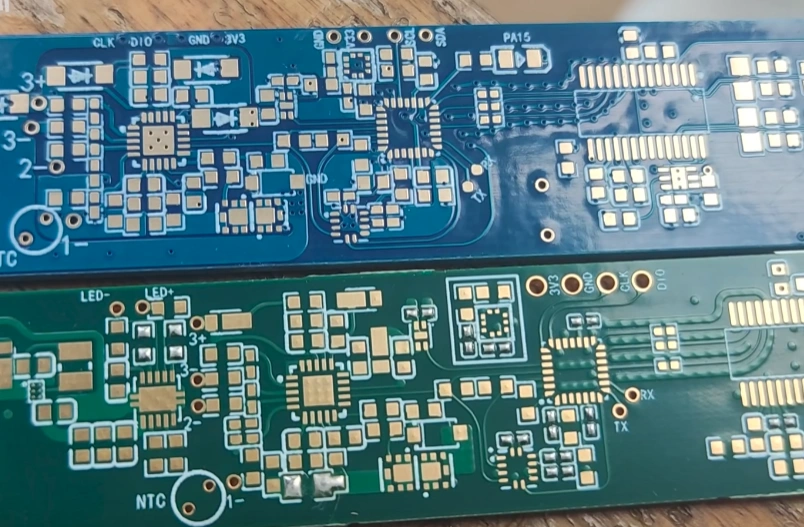
ENIG is generally flatter than HASL, which is why it is commonly preferred for fine-pitch PCB assembly. A flat pad gives solder paste and a small component termination a more consistent starting surface. HASL’s solder coating can be uneven enough to matter when component pads are very small or when component coplanarity is tight.
This is not a blanket rule that HASL cannot be used on SMT boards. Many assemblies use HASL successfully. The correct decision depends on the package, pitch, land pattern, solder-paste process, placement equipment, and the fabricator’s demonstrated capability. For a dense BGA, QFN, or fine-pitch leaded package, ask both the board fabricator and assembly team to review the smallest pad and pitch rather than choosing by finish name alone.
ENIG vs. HASL for PCB assembly
Surface finish affects assembly, but it is one variable in a larger soldering system.
| Assembly question | ENIG | HASL / lead-free HASL |
|---|---|---|
| Fine-pitch SMT or dense BGA | Usually the safer starting point because of flatness | Review carefully; pad unevenness may reduce the assembly margin |
| Through-hole or larger SMT parts | Suitable | Often suitable and cost-effective |
| Solder-paste printing | Flat pads can support predictable coplanarity for printing and placement | Raised or uneven solder can reduce the process margin on very small pads |
| Rework | Use a validated rework process and inspect the pad condition after rework | Use a validated rework process and inspect the pad condition after rework |
| Storage before assembly | The gold layer protects the nickel surface; follow the fabricator’s packaging and storage limits | Follow the fabricator’s packaging and storage limits for the selected alloy and finish |
The finish cannot compensate for poor land patterns, moisture damage, contamination, incorrect solder paste, or an uncontrolled reflow profile. Coordinate the board finish, paste, stencil, and component packages early in the SMT reflow process.
Is ENIG more expensive than HASL?
ENIG is usually more expensive than HASL, but the difference is specific to the board and supplier. ENIG requires more chemical steps and uses nickel and gold, while HASL uses a molten solder process. The quoted difference can also change with board size, panel utilization, layer count, pad density, surface-finish area, quantity, lead time, and the supplier’s process.
Do not select HASL only because it is assumed to be cheap, or select ENIG only because it sounds premium. A lower board price can be a false economy if a finish creates unnecessary assembly risk. Conversely, ENIG can add cost with little benefit on a board using large, forgiving pads. Request the same fabrication data in both finishes when cost is material to the decision, then compare the complete fabrication and assembly impact.
Is lead-free HASL the same as ENIG?
No. Lead-free HASL and ENIG are different surface-finish systems. Lead-free HASL is a hot-air-leveled coating made from a lead-free solder alloy. ENIG is a nickel-and-gold finish. Both can be used in lead-free assembly, but they differ in flatness, process chemistry, cost, and the way they interact with soldering.
Lead-free HASL is not automatically a poor choice for modern products. It can be appropriate where its planarity and fabrication limits fit the design. ENIG is not automatically required by RoHS or by lead-free solder paste. RoHS compliance, where applicable, depends on the relevant in-scope materials, any claimed exemptions, and supplier declarations; a single lead-free surface finish does not establish product compliance. The fabrication data should state the finish and alloy, together with the applicable rigid-board requirements, such as the invoked revision of IPC-6012F.
Reliability and corrosion considerations
Both finishes can be reliable when the PCB is manufactured and assembled within a qualified process window. Neither finish should be chosen on a generic claim that it is “the reliable one.”
ENIG’s gold layer protects the nickel before soldering, but a gold appearance does not prove a sound nickel interface. ENIG process failures, including black-pad-type nickel corrosion, can affect solder-joint formation. Evaluate the fabricator’s process controls and the agreed inspection or test requirements for a high-reliability program.
HASL creates a solderable solder coating, but its uneven profile can create assembly challenges on certain packages. Its performance also depends on alloy selection, board handling, storage, flux, solder paste, and the reflow or wave-solder process. In either case, treat surface finish as a specified material and process requirement, not as a cosmetic selection.
Philifast — PCB Manufacturing & Surface Finishing
We provide ENIG, HASL, and lead-free HASL finishes with qualified process controls for reliable assembly.
When should you choose ENIG?
ENIG is commonly a good fit when one or more of these conditions apply:
- The design uses fine-pitch ICs, BGAs, QFNs, or other packages where pad flatness is important.
- The board has dense SMT placement and limited tolerance for inconsistent paste transfer or component seating.
- The product needs a nickel-and-gold surface finish specified by a customer, drawing, or qualification plan.
- The total cost of an assembly defect is larger than the incremental fabrication cost of ENIG.
Specify ENIG by its required finish standard, drawing notes, and customer requirements where applicable. Do not specify it simply as “gold plating,” because ENIG, hard gold, and other gold-containing finishes serve different purposes. In particular, ENIG is not a substitute for hard gold on a high-wear edge connector.
When should you choose HASL or lead-free HASL?
HASL or lead-free HASL is commonly a good fit when:
- The design uses through-hole parts, larger SMT packages, or mixed technology without extremely tight planarity needs.
- Cost sensitivity is high and the fabricator confirms that HASL meets the smallest pad and spacing requirements.
- The assembly process is qualified for the selected solder alloy and finish.
- The product requires a lead-free process and lead-free HASL meets the design, customer, and compliance requirements.
State whether tin-lead HASL or lead-free HASL is required. “HASL” alone can be incomplete because the alloy choice affects the manufacturing process and product requirements.
A practical decision process for designers and buyers
Use this sequence before releasing fabrication data:
- Review the smallest package and pad geometry. Identify fine-pitch parts, BGAs, QFNs, and bottom-terminated components that may need a flatter surface.
- Match the finish to the assembly process. Review solder paste, stencil apertures, reflow profile, wave or selective soldering, and rework plans with the assembly team.
- Define compliance and material requirements. State lead-free requirements, applicable standards, finish type, and any customer-specific workmanship criteria.
- Ask the fabricator about manufacturability. Confirm available finishes, minimum feature capability, expected pad profile, storage and handling guidance, and any design constraints.
- Compare total risk, not only board price. Include potential assembly yield, inspection, rework, and field-reliability consequences in the choice.
For context on where the finish sits in the overall fabrication flow, see Philifast’s multilayer PCB manufacturing process guide.
Common misconceptions
“ENIG is always better than HASL.”
No. ENIG usually offers better flatness, but HASL can be an effective, economical finish for many boards. The better option is the one that meets the actual package, assembly, compliance, and cost requirements.
“Lead-free HASL means ENIG is unnecessary.”
Not necessarily. Lead-free HASL addresses the solder alloy, not the flatness difference between HASL and ENIG. A fine-pitch design may still justify ENIG, while a less demanding design may be well served by lead-free HASL.
“The gold color means ENIG works for edge connectors.”
No. ENIG is designed as a solderable surface finish. Edge connectors subject to repeated insertion and abrasion commonly require a separately specified hard-gold finish and suitable connector design.
“Surface finish alone determines solder-joint reliability.”
No. Reliability also depends on pad design, board materials, component finish, solder paste, thermal profile, contamination control, inspection, and the product environment.
Philifast — Expert Guidance on PCB Surface Finishes
Let our engineering team help you choose between ENIG and HASL based on your real design requirements.
PREGUNTAS FRECUENTES
Which is better for fine-pitch components: ENIG or HASL?
ENIG is usually the better starting point because its pads are flatter. That can reduce assembly risk for fine-pitch components, BGAs, QFNs, and other packages with small solderable areas. Confirm the final choice with the PCB fabricator and assembler because package geometry and process capability still matter.
Is ENIG better than lead-free HASL?
ENIG is generally flatter and often better suited to dense fine-pitch assembly. Lead-free HASL can be less expensive and works well for many boards with less demanding pad-flatness requirements. Lead-free status does not make the two finishes equivalent.
Is ENIG more corrosion resistant than HASL?
ENIG’s gold layer protects the nickel surface before soldering, which can be useful for handling and storage. However, neither finish should be selected on a broad corrosion claim alone. Storage, packaging, contamination, finish quality, and the product environment all affect the result.
Does ENIG improve electrical performance?
ENIG is chosen mainly for solderability and pad flatness, not as a general signal-integrity upgrade. Electrical performance is governed primarily by the stack-up, copper geometry, dielectric materials, impedance control, and layout. Surface finish may still matter for specific contact or assembly requirements.
Which finish is better for PCB prototypes?
Either can be appropriate. Use ENIG when the prototype includes fine-pitch packages or needs to represent a planned production finish. Use HASL or lead-free HASL when the design is compatible and cost is the higher priority. Keeping the prototype and production finish aligned can reduce surprises during validation.
Philifast — Your PCB Manufacturing Partner
From surface finish selection to full assembly, we deliver reliable boards worldwide.