

















With the continuous growth of the electronics industry, there are more and more types, brands, and makers of components. This also means higher demands for people who work in component purchasing. As the saying goes, details decide success or failure. Many things need attention, such as model, lead time, package, and batch. When buying electronic components, it is not enough to know only the model. You also need to know the detailed specs before you can buy the right part. Below, we share knowledge about electronic component purchasing and trading skills.
How to Tell Whether Electronic Components Are Real or Fake
The first and most important thing is to tell whether the parts are real. In general, original electronic parts will have three pieces of information printed on the blank area of the part: the maker, the part number, and the production date.
Check the Maker Mark
Showing the maker is a responsible practice. Some parts print the company’s English name directly. Some companies print their own special symbol to show the maker. Some also print the place where the part was made.
Check the Model and Spec Information
When purchasing, pay attention to the model, part number, quantity, and performance. There are still many fake electronic parts on the market, so you need to be extra careful about whether they are from the original maker.
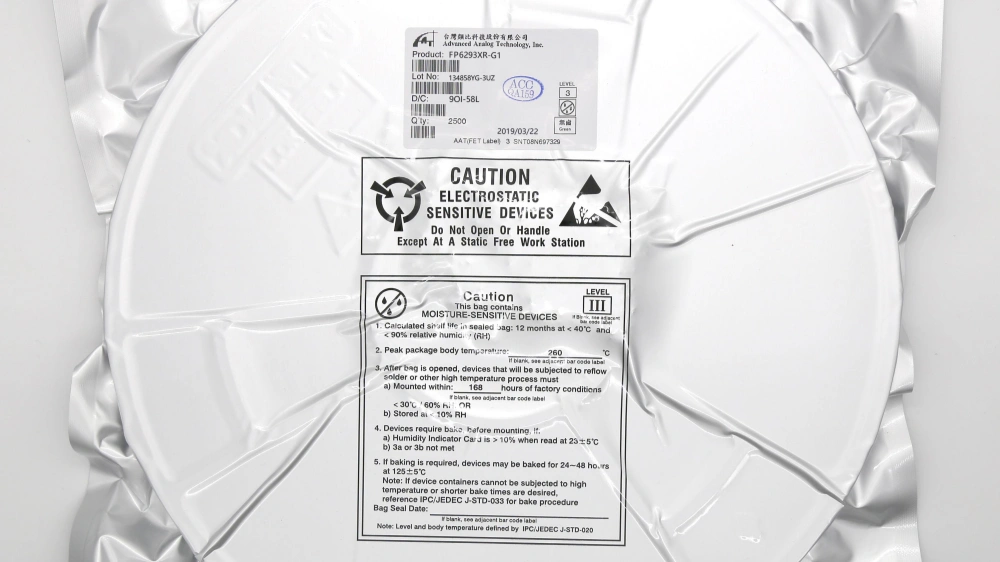
Check the Part Number
Next, check the part number. The part number shows the special spec and use rules of that part. In most cases, parts with the same number should be interchangeable. But in some special cases, small hardware differences can cause the whole electronic circuit to work abnormally. In this area, it often takes long-term study to find the real reason.
Basic Types of Electronic Components
(1) Active Components and Passive Components
An active component is a part that gets energy from current direction, or depends on current direction. Examples include transistors, thyristors, diodes, and valves.
A passive component is an electronic part that can do its function without needing an energy source.
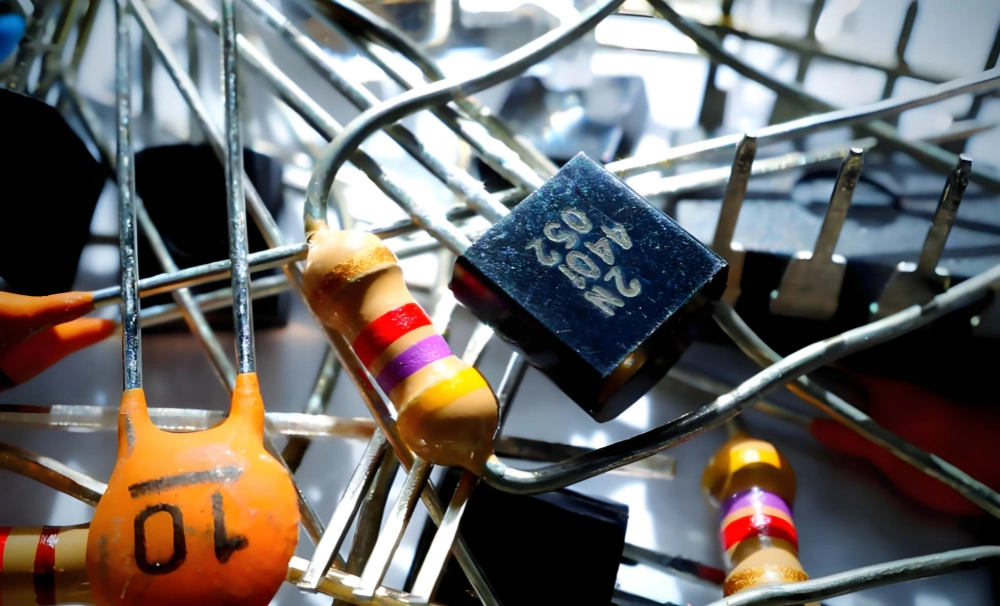
(2) Powered Components and Non-Powered Components
Parts that need a power source are called active devices. Parts that do not need a power source are called passive devices.
Active devices are usually used for signal amplification, conversion, and similar tasks. Passive devices are used for signal transfer, or for “signal amplification” through direction control. Capacitors, resistors, and inductors are passive devices. ICs, modules, and similar parts are active devices.
(3) Discrete Components and Integrated Circuits
A discrete component circuit is a circuit made by connecting single electronic parts together. If discrete parts are used to build a complex circuit or system, the number of parts will be very large. This will increase size, weight, and power use, and reliability will also be lower.
Electronic Component Purchasing Process
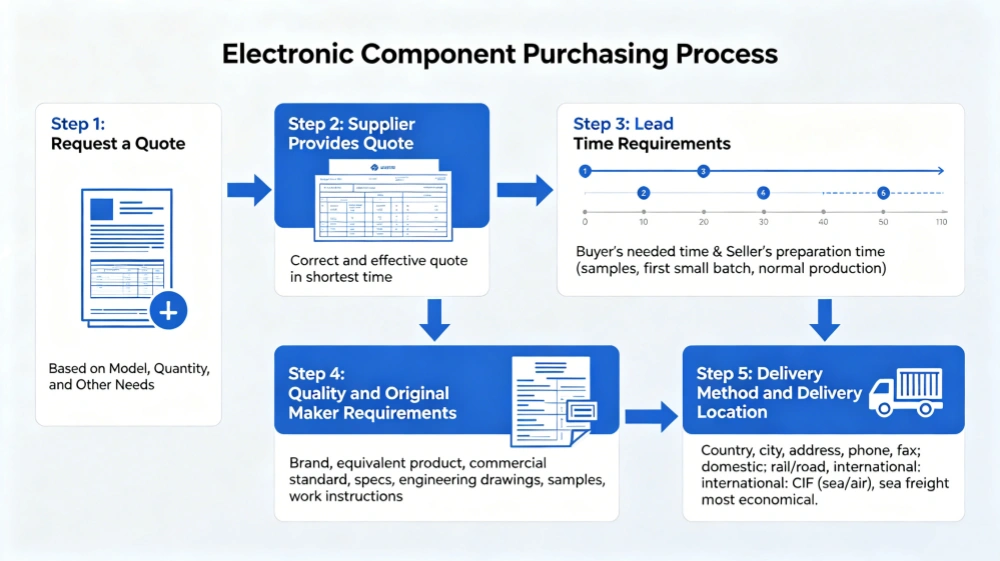
- Request a Quote Based on Model, Quantity, and Other Needs
The supplier should give a correct and effective quote in the shortest time based on the request file. - Lead Time Requirements
Lead time requirements include the time the buyer needs for the purchased products, and the time the seller needs to prepare samples, the first small batch, and normal production orders. The supplier can match the buyer’s needs, but lead time is tied to product price. The buyer should make requests based on real needs, not just keep chasing faster delivery. - Quality and Original Maker Requirements
There are many ways to state quality rules for a quote request. Usually, the following can be used: brand, or equivalent product, commercial standard, material and manufacturing method specs, performance specs, engineering drawings, samples, and work instructions. - Delivery Method and Delivery Location
The country, city, address, phone number, and fax number of the delivery place must be clearly told to the supplier. In domestic trade, delivery is mainly by rail or road. In international purchasing, the delivery place and delivery method decide the price calculation. If the seller is asked to quote CIF, then whether by sea or air, the transport fee and insurance fee are paid by the seller. The fee method changes with distance. Unless the buyer asks for air transport, suppliers usually quote based on sea freight, because sea freight is the most economical delivery method.
Key Things to Note During Purchasing
The four points above are common issues in component purchasing. Here are some more notes:
Purchasing is not just about placing orders at the lowest price. Always chasing the lowest unit price is a big mistake. Another wrong idea is that purchasing means changing suppliers often. Also, do not ignore the production batch number. When buying, ask clearly about the batch number, or it may affect inventory and shipment rate.
Be careful about the packaging and testing trap. The original maker’s wafer fab site and packaging and testing site are usually not in the same place. Many original makers have several wafer fab sites and packaging and testing sites, and this also includes their contract factories. The chip package or top mark may only show the packaging and testing site. Sometimes customers will ask for the origin of the product, and this is also something we need to pay attention to.
What Are the Common Electronic Component Purchasing Channels?
For electronic component buyers, finding a formal and reliable purchasing channel is very important, because it can directly affect purchase quantity, product quality, and price.
So, what are the common channels for electronic component purchasing? Here is a simple look.
At present, the main purchasing channels for electronic components are these four types:
- Agents: divided into first-level agents, second-level agents, and so on.
- Distributors: divided into authorized distributors, agent distributors, and informal distributors.
- Traders: divided into general taxpayers and individual business owners.
- Electronic component trading platforms (including self-operated platforms or maker stores)
Agents
In the electronics industry, a company with an agency certificate and original maker authorization, or a large distributor that has had strong cooperation with the original maker, is an agent. Its advantage is strong capital support, plus the ability to stock goods for customers and control inventory.
Traders and Distributors
Traders and distributors exist to make up for the “gaps” left by agents. They often hold a large amount of inventory and ready stock, which gives strong support to small and medium traders and distributors.
But because the market is mixed and full of all kinds of component suppliers, quality control is very different from one trader to another. Some even sell fake or copied parts, so a small mistake can lead to being cheated.
Electronic Component Trading Platforms
The Internet brings great convenience to users, and the same is true for electronic trading platforms. Today, there are many online component platforms, and the product range is very wide, including self-operated products and products from original makers. This lets users search and buy parts quickly and easily.
Choose Philifast for Electronic Component Purchasing
Get complete one-stop service from component sourcing to finished product assembly
Philifast Component Purchasing Advantages
As electronic products update faster and faster, companies now want more than just buying parts. They also want stable supply chain support, reliable product quality, and efficient production and delivery. Because of this, more and more companies are choosing one-stop service providers with component purchasing, PCB manufacturing, and PCBA assembly abilities.
Based on a complete supply chain system and rich electronics manufacturing experience, Philifast can provide one-stop electronic manufacturing services, including electronic component purchasing, PCB manufacturing, SMT assembly, DIP assembly, testing, and finished product assembly.
1. Regular supply chain channels
We keep long-term cooperation with original makers, authorized agents, and high-quality distributors, so the source of parts is reliable and the risk of fake and refurbished parts is lower.
2. Rich purchasing experience
We are familiar with component models, packages, substitute part selection, and life cycle management. We can help customers solve problems with end-of-life parts, out-of-stock parts, and hard-to-find parts.
3. Strict incoming quality control
We perform visual checks, model checks, and incoming inspection on purchased components to make sure products meet production needs and improve PCBA reliability.
4. Lower purchasing cost
With the advantage of bulk buying and stable supply channels, we help customers get more competitive prices and reduce the total manufacturing cost.
One-Stop Electronic Manufacturing Service
For R&D teams and electronic product makers, finding component suppliers, PCB makers, and PCBA factories one by one often takes a lot of time and communication cost.

