
PCB Materials & Stackups
Choose the board material around your circuit, assembly process and operating environment. Send FLJ your existing stackup, drawing or application details, and we will help match the construction to your project.
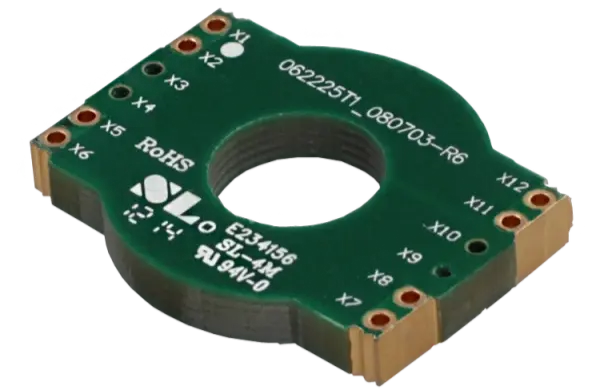
A material choice is more than a laminate name
PCB material is the insulating substrate and bonding system that supports the copper circuitry. A multilayer stackup describes how those materials and copper layers are arranged.
Two boards described as FR4 can behave differently during reflow or in a high-speed circuit. Resin system, glass construction, copper weight, dielectric thickness and the specific laminate grade all matter. We review these together so the quoted construction supports the intended use.
If your design already names a grade, send it as it stands. If it only says FR4, explain the application and any temperature, signal or mechanical concerns. You do not need to choose every material detail before contacting us.
Material families for different PCB applications
FLJ’s published capability information includes conventional FR4, high-Tg and low-loss laminates, RF materials, flexible substrates and metal-based constructions.
| Material family | Typical design reason | What we discuss |
|---|---|---|
| Standard FR4 | General control, consumer and industrial electronics | Layer count, thickness, copper and assembly conditions |
| High-Tg FR4 | Greater resistance to elevated processing temperatures | Tg, decomposition behavior, expansion and reflow profile |
| Low-loss and RF laminates | Signal integrity and RF transmission | Frequency, Dk/Df data, copper type and impedance geometry |
| Polyimide flex materials | Bending, folding and compact interconnections | Static or dynamic flex, bend region and reinforcement |
| Metal-core constructions | Heat transfer from power devices and LEDs | Dielectric thermal performance, insulation and metal base |
| Ceramic substrates | Special thermal and electrical applications | Substrate type, metallization and mechanical requirements |
Laminate grades and sourcing
Our published material list includes Shengyi S1141 and S1600, Kingboard KB6160A and KB6167F, Isola FR408 and FR408HR, Panasonic Megtron families, and Rogers RF laminates. These examples help establish the range of material discussions; exact grades, thicknesses and purchasing availability are checked for each quotation.
For a nominated material, we review the current manufacturer data sheet and the board construction. A high Tg value alone does not establish low electrical loss or the best thermal reliability. The frequency and test method also matter when comparing dielectric data.
Where a grade is difficult to source, we can discuss alternatives against the properties that matter to your design. A proposed equivalent is reviewed with you before it becomes the production choice.
Build the stackup around the electrical and mechanical needs
A useful stackup connects circuit requirements with a construction that can be manufactured consistently.
For controlled-impedance designs, send the target values and any existing layer plan. We review trace geometry and the proposed dielectric construction together, rather than changing one independently of the other. The agreed stackup and impedance conditions form part of the job information.
| Stackup detail | Why it matters |
|---|---|
| Copper layer order | Defines signal routing, reference planes and power distribution |
| Core and prepreg thickness | Sets dielectric spacing and contributes to finished board thickness |
| Copper weight | Affects current carrying needs, etching geometry and final dimensions |
| Impedance targets | Connects trace width, spacing and dielectric properties |
| Construction symmetry | Helps manage the effects of lamination and assembly |
| Flex and rigid transitions | Connects bend requirements with rigid support and interconnection design |
Material data to compare for your application
Use the exact material grade to compare properties. Share a nominated grade or the electrical and thermal goals, and we can help review the construction.
| Property group | Useful data | Comparison context |
|---|---|---|
| Thermal behavior | Tg, Td and Z-axis CTE | Exact laminate grade, test method and temperature range |
| RF and signal loss | Dk, Df and copper type / roughness | Frequency, test method and stackup used in the comparison |
| Electrical insulation | CTI, dielectric strength and insulation data | Manufacturer data sheet and product operating conditions |
| Moisture and processing | Water absorption and recommended processing | Material construction, storage and soldering history |
| Flex construction | Film, copper, adhesive and stiffener | Bend region and connector thickness |
| Thermal substrates | Dielectric thickness, thermal conductivity and isolation | Specific metal-core material system rather than bulk-metal properties |
Material data comes from the selected manufacturer grade. A Tg value or brand name alone does not establish an equivalent replacement.
Material information for purchasing and repeat builds
Tell us if material identity is important for customer approval, qualification or repeat production. We can discuss the grade identification, supplier documentation and job records needed for your purchasing process, and include the agreed documentation in the order scope.
Material performance data, RoHS/REACH documentation and factory quality-system certificates answer different questions. This page helps select the construction; the material compliance and certification pages cover the supporting documentation. For a repeat order, share the previous board revision so any material or stackup change can be reviewed together.
Start with the files you have. A drawing, laminate callout or short application description is enough to begin the discussion, and our team will follow up on the details that affect the quotation.
Frequently asked questions
Can FLJ help if my drawing only specifies FR4?
Yes. Send the drawing and describe the application. We can discuss a suitable grade and construction based on the board thickness, assembly process and electrical needs.
Does a higher Tg always mean a better PCB?
No. Tg describes one thermal property. Electrical loss, expansion, moisture behavior and the construction may matter more for a particular application.
Can you use the laminate grade already specified in my design?
Send the exact grade and thickness details. We will check the manufacturing route and purchasing availability, then discuss any options with you.
Can a material be substituted on a repeat order?
A proposed substitution should be reviewed against the design and purchasing requirements. We discuss the change with you before agreeing the production construction.
Let’s review your next build
Send your available board files, drawings or project questions. Our team will review the information and follow up with you about the next step.