
FR-4 PCB
Manufacturing
The material behind everyday electronics.
The board built for your product.
FLJ manufactures FR-4 printed circuit boards for prototypes and production, from simple control boards to dense multilayer circuits. Choose the material grade, copper and finished construction for your application, with PCB assembly available alongside bare-board fabrication.
A stable circuit platformGlass reinforcement supports the board and its components.
Electrical insulationThe resin-and-glass dielectric separates the copper circuitry.
Practical production economicsEstablished materials and fabrication routes serve a wide range of electronics.
The Material Behind an FR-4 Board
FR-4 is a family of flame-retardant, glass-reinforced epoxy laminates. The finished PCB brings that insulating structure together with the copper circuit.
Woven glass fabric gives the laminate mechanical reinforcement. Cured epoxy binds the fabric and forms the insulating matrix around it. Copper foil bonded to the laminate becomes traces, pads and planes during fabrication.
The familiar green surface is usually solder mask, a separate protective coating over selected areas of the outer circuit. Its color does not identify the laminate grade beneath it.
Core and prepreg: the same material system, different jobs
A copper-clad core is already cured. Prepreg contains partially cured resin and reinforcement for bonding the layers of a multilayer board. During pressing, its resin flows around the copper features and cures. Glass style, resin content and pressing determine the resulting dielectric construction. That finished spacing, together with the material properties, matters when setting an impedance geometry.
See how a multilayer PCB is built →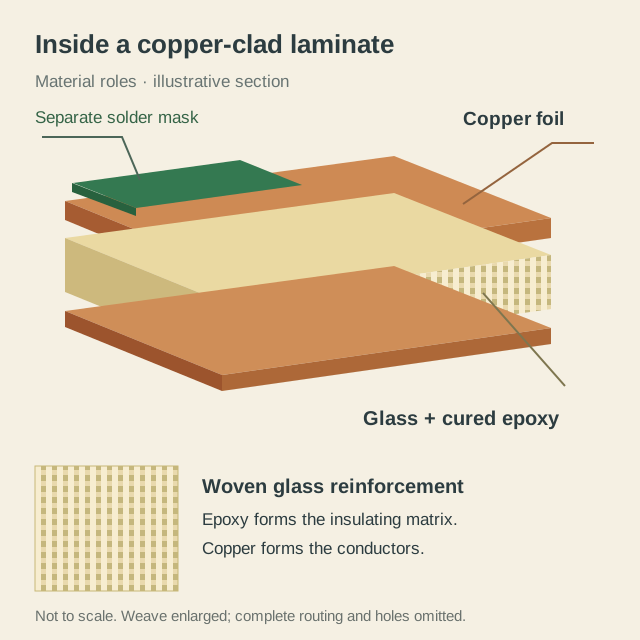
Choose the FR-4 Grade for the Application
Two FR-4 boards can have different thermal and electrical behavior. The resin system, glass construction and material grade matter alongside the board’s layer count and thickness.
| Material direction | Where it earns its place | What makes the difference |
|---|---|---|
| General-purpose FR-4 | Control, interface, instrumentation and everyday electronic circuits. | A practical balance of insulation, mechanical support, availability and cost. |
| Higher thermal performance | Constructions facing greater assembly heat exposure or more demanding thermal cycling. | Glass transition, decomposition resistance and expansion behavior work together. |
| Lower-loss material systems | Longer or faster signal paths where dielectric loss becomes significant. | Grade-specific Dk and Df, glass construction and the electrical geometry. |
| Application-specific properties | Products with halogen, tracking-resistance or moisture-bias reliability needs. | Halogen-free, high-CTI and CAF-resistant properties are separate material choices. |
More than a Tg number
Tg marks a change in the resin’s mechanical state. Above that transition, stiffness and expansion behavior change. Td describes decomposition under a specified thermal test. Reflow and rework expose the complete copper-and-laminate structure to heat, so the resin transition, decomposition resistance and expansion response are considered together. Tg is not the board’s continuous operating-temperature rating.
Expansion also has a direction. Through-thickness movement of the laminate loads the plated copper in a hole as the board heats and cools. The grade’s expansion behavior, board thickness, hole construction and thermal exposure all influence that stress.
Compare PCB materials and stackups →Match the dielectric to the signal path
Dk affects propagation and, together with the trace and reference-plane geometry, characteristic impedance. Df describes dielectric loss. Both depend on the material construction and the conditions under which they are measured.
A high-Tg material is not automatically a low-loss material. FR-4 can support controlled-impedance circuits; longer and faster channels may benefit from a lower-loss construction. The signal path, rather than a universal frequency cutoff, determines when a specialty laminate is useful.
Surface insulation and internal reliability
CTI concerns resistance to surface tracking. CAF resistance concerns conductive filament growth within the laminate, which can develop under moisture and electrical bias. A CAF-resistant grade addresses one part of the internal reliability problem; conductor spacing, fabrication and the service environment also matter. Neither property follows automatically from a high-Tg label. Halogen-free status is another independent material requirement.
Manufacturing with the Material in Mind
The selected resin system carries through to the factory process. FLJ controls material storage and handling and uses the lamination conditions suited to the chosen laminate and prepreg. Resin flow must fill around copper features, while cure and pressure establish the bonded dielectric structure. Conditioning follows the material and its exposure history.
Material identity matters from one build to the next. Retaining the selected manufacturer, grade and construction keeps a repeat order tied to the material choice behind the original design. A change in grade can alter expansion, electrical loss and processing behavior even when the board outline stays the same. Lot traceability connects the supplied laminate with the manufacturing record.
Copper-pattern inspection and bare-board electrical testing check the fabricated circuit. Dimensional checks address the finished physical board, while microsections and impedance measurements examine the relevant construction features. Material records and board tests provide different information.
Get your FR-4 PCB into production.
Send the fabrication files, quantity and target date. Include the material grade if specified, or the available board thickness, copper, finish and electrical requirements. FLJ supplies the bare boards or continues with assembly.