
ImAg · Silver directly on copper
Immersion Silver PCB Manufacturing
A thin, solderable silver surface for fine-pitch assemblies and selected RF designs.
FLJ manufactures immersion-silver PCBs for prototype and production orders. Bare-board fabrication, selective finish regions and component assembly can be supplied for the same build.
Prototype to production
Immersion Silver PCB Capabilities
The thin silver layer protects exposed copper before component soldering and preserves a solderable surface for assembly. FLJ supplies immersion-silver bare boards or carries them into component assembly, with the finish included in the PCB construction.
Board Fabrication and Selective Finishes
The finish can be specified for the soldering regions of the board, including builds with separate gold-finger contacts. The silver areas and contact areas retain their own surface requirements.
Processing dimensions refer to the panel or workpiece that passes through finishing. Smaller delivered boards can be processed in a larger panel.
| Manufacturing item | Reference |
|---|---|
| Processing edge length | Single edge <500 mm |
| Minimum processing panel | 60 × 80 mm |
| PCB thickness | 0.3–3.0 mm |
| Finishing-route aspect ratio | 10:1 |
These are finishing-route references. The aspect ratio is distinct from the mechanical-drilling capability. Silver-layer thickness is specified separately from PCB thickness.
Choose the surface for its task
Silver Surfaces for Assembly and RF Designs
A thin silver finish brings together planar soldering lands and a conductive metal surface. Its usefulness depends on what the exposed region must do in the finished board.
Planar Lands for Fine-Pitch SMT
The thin finish adds little build-up over the copper pads. This is useful for fine-pitch SMT and BGA footprints where pad topography matters to solder-paste printing and component attachment.
FLJ can take the same finished boards through SMT printing, placement and reflow. Immersion silver offers an economical metal-finishing route without a nickel-and-gold layer stack.
Nickel-Free Finishing on RF Features
At an immersion-silver land or exposed conductor, silver is deposited directly on copper without a nickel underlayer. This provides a nickel-free finish option where the surface metal is part of an RF transmission-line or connector-transition design.
The complete conductor geometry, copper surface and finish belong in the loss assessment. Our high-frequency PCB manufacturing service combines the selected laminate with the copper features and exposed-surface requirements of the RF board.
Conductive Areas and Contact Requirements
A silver-finished region can provide a conductive surface for suitable probing or shielding contact arrangements. Contact pressure, exposure and the number of mating operations affect the surface required at that location.
Repeated wiping contacts can use a different finish, such as a hard-gold contact surface, alongside soldering regions. The wider surface-finish selection distinguishes solder pads, connector contacts and bonding areas.
The copper–silver interface
Immersion Silver Manufacturing and Finish Control
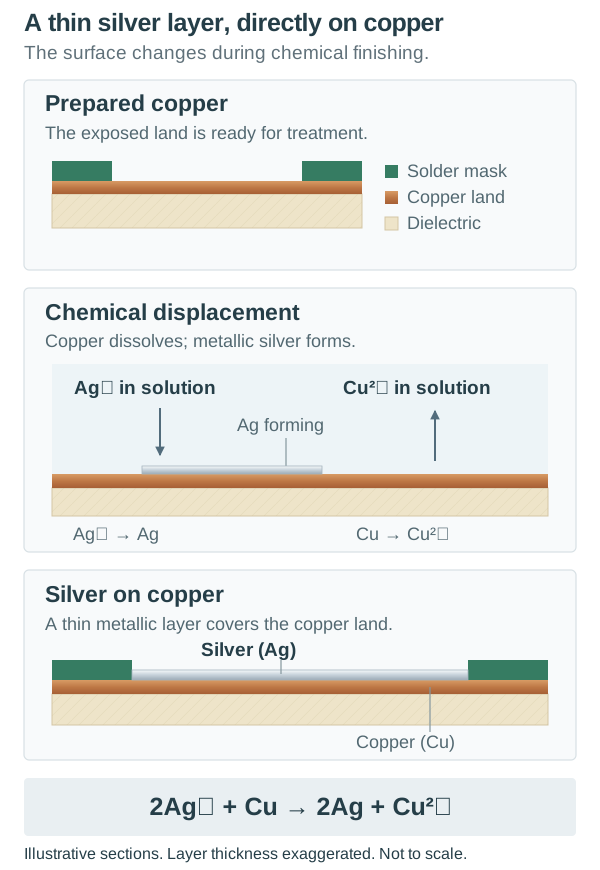
FLJ prepares the exposed copper, forms the silver layer by chemical displacement, and cleans and protects the finished surface for delivery. Copper preparation and silver deposition work together to produce the intended thin finish.
Preparing the Exposed Copper
Cleaning removes oils, handling contamination and unwanted surface residues. Controlled micro-etching and the appropriate pretreatment establish the copper condition required by the selected finishing system.
Rinses between treatments control carryover. Surface preparation must reach the intended copper features consistently so that the subsequent silver deposition can form a uniform finish.
Forming Silver by Chemical Displacement
Silver ions in the treatment solution are reduced to metallic silver while copper at the surface is oxidized and enters solution. The silver forms directly on the copper, creating the thin metal layer supplied on the finished board.
The reaction can be written as 2Ag+ + Cu → 2Ag + Cu2+. The reaction couples silver deposition to copper dissolution. Treatment chemistry and exposure are controlled to form continuous silver coverage while limiting unwanted attack on the copper surface. Consistent preparation helps the solution reach the intended features uniformly; the resulting coating amount and coverage must suit the specified finish.
The layer is typically on the scale of a few tenths of a micrometre. For unit reference, 10 µin = 0.254 µm. The build specification sets the required silver-layer thickness.
Rinsing, Drying and the Supplied Surface
After deposition, final rinses clear treatment residues from the silver surface. Drying and the finishing system’s compatible protection treatment prepare the boards for packing. Clean, consistently treated lands are then carried into protected handling and delivery.
The finished features are examined for the intended silver coverage, surface contamination or damage, with coating amount evaluated against the finish requirement. For a build that needs evidence after storage or earlier assembly heating, solderability testing evaluates wetting on the relevant lands under the planned joining conditions.
Keep the finished surface ready
Protecting the Finish Through Delivery and Assembly
Immersion silver needs protection from direct handling, contamination and unsuitable exposure. Sulfur-containing contaminants can react with silver to form silver sulfide, changing the exposed surface.
FLJ separates boards to limit rubbing against the silver-finished lands and uses packaging materials compatible with the surface. Materials in contact with the boards are selected to avoid sulfur-bearing or other contaminating exposure, keeping the finished silver ready for the planned assembly.
From Finished Boards to Component Assembly
Unopened boards remain in their specified protective packaging until production is ready. On the assembly line, clean handling and coordinated printing, placement and soldering reduce the time the silver lands remain exposed and the need to handle them again.
For boards held between operations, retain the packing and exposure conditions with the assembly plan. Any required moisture conditioning is arranged around both the board construction and the silver surface. If handling or exposure leaves the condition uncertain, evaluation focuses on the lands and soldering operation that will actually be used.
FLJ supplies bare boards or coordinated board fabrication and assembly, carrying the chosen finish into the delivered build.
Specify Your Immersion Silver PCB Build
Send the board files, quantity and silver-finish requirements. Include component assembly and any separate contact-finish areas in the quotation scope.