Design and manufacturing capabilities
| Design layer-count capability | 1–32 layers |
|---|---|
| Minimum line width and spacing | 3mil |
| Minimum laser-drilled hole | 4mil |
| Minimum mechanically drilled hole | 8mil |
| Copper foil thickness | 18–175 µm (standard values: 18 µm, 35 µm and 70 µm) |
| Peel strength | 1.25N/mm |
| Minimum punched-hole diameter | Single-sided: 0.9 mm / 35 mil |
| Minimum hole diameter | 0.25mm/10mil |
| Hole-diameter tolerance | For diameter ≤0.8 mm: ±0.05 mm |
| Hole-diameter tolerance | ±0.05mm |
| Plated-hole wall copper thickness | Double-sided / multilayer: ≥0.8 mil |
| Hole resistance | Double-sided / multilayer: ≤300 µΩ |
| Minimum line width | 0.127mm/5mil |
| Minimum spacing | 0.127mm/5mil |
| Legend-colour options | Black, white, red, green and other colours |
| Surface-finish options | Leaded or lead-free HASL, ENIG, silver and OSP |
| Service | OEM services |
| Quality and compliance references | ISO 9001 / RoHS / UL |
Rigid-flex layout and packaging
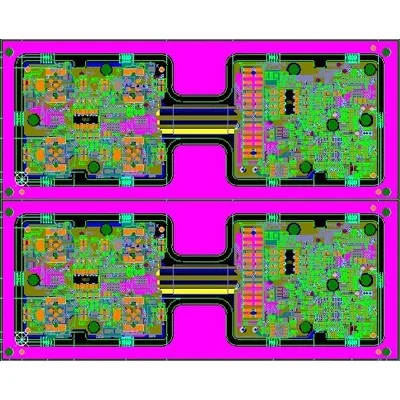
An ultra-thin profile and a shape that can be adapted to the enclosure make rigid-flex PCBs useful in thin, lightweight electronic packaging. Although their design and manufacturing can cost more than conventional rigid boards, they address several interconnection and packaging limitations.
Five advantages of rigid-flex PCB construction
1. Compact size and a flexible shape
A rigid-flex board can change shape to follow the required outline, making it easier to fit more components into less space. This can reduce the finished product size, weight and overall system cost. The compact format also suits fine-line, high-density HDI circuitry.
2. Customization for different applications
The freedom to define the package geometry supports aerospace, defense, medical-equipment and consumer-electronics applications. Board size and shape can be customized to enclosure and three-dimensional packaging requirements.
3. Mechanical stability
The stability of a rigid PCB and the flexibility of an FPC combine into an integrated structure. This maintains the electrical interconnections while allowing installation in a confined space.
4. Performance in demanding environments
Rigid-flex construction can be designed for shock and vibration. Using fewer cables and connectors also reduces the number of separate interconnections that require maintenance and consideration during later use.
5. Assembly and testing
Fewer interconnections and associated parts simplify assembly operations and make the circuit easier to assemble and test. These characteristics also make rigid-flex construction useful for PCB prototypes.