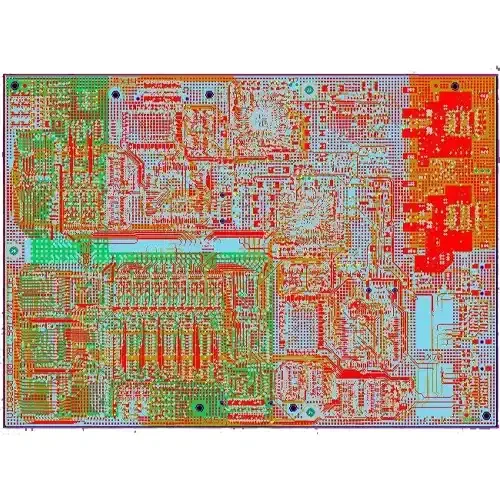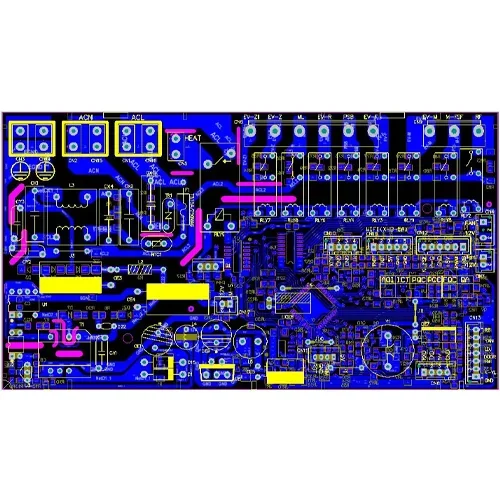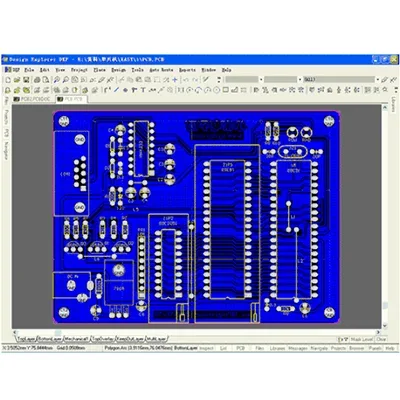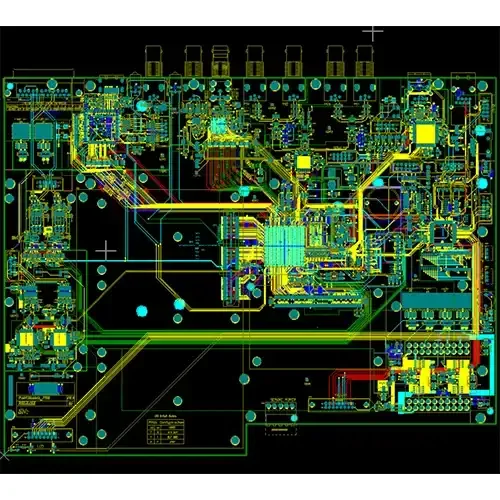
PCB design parameters
| Design requirements | Length matching for data, address and clock signals, with package-level processing |
|---|---|
| PCB layers | 6 layers |
| PCB surface finish | Immersion gold |
| Laminate / board specification | Htg170, 1.6mm, 1oz |
| Routing parameters | 5/5mil, Via: 8mil |
| Impedance control | +/-10% |
I/O and system integration reference
| Power supply | 24VDC |
|---|---|
| Equipment interfaces | 3 × RS485 (dimming, colour and sensor connections) |
| Network interface | 1 × RJ45 (100M) |
| Wireless communications | 1 × 4G (multi-network, MQTT protocol); 1 × LoRa |
| Outputs | 16 × digital outputs (220 VAC @ 10 A) |
| Audio power amplifier | 60 W audio power amplifier |
| Memory and storage | 512M DDR3; 8G eMMC |
CPU functions within a core module
The CPU is a central part of the core board. Its control and arithmetic functions coordinate the work of the computer. Regardless of CPU type, its internal functions can be described in terms of a control unit, a logic unit and storage functions that work together to analyze, judge, calculate and coordinate the different parts of the system.
The role of a core board
A core board packages the essential functions of a mini PC on an electronic motherboard. It commonly integrates a CPU, storage devices and connection pins that link it to a matching carrier board or backplane.
This arrangement provides an embedded system or development platform for a particular application. Because the reusable core functions are contained in a separate module, different carrier boards can be developed around the same core. This improves development efficiency, reduces development complexity and supports system stability and maintainability.
Memory and storage
Memory stores programs and data required by the computer. Storage can be divided into primary memory and auxiliary or external storage.
External storage can use magnetic or optical media such as hard drives, floppy disks, tape and optical discs. These media retain information without continuous power; mechanical storage is considerably slower than CPU operations.
Main memory is the board-level storage with which the CPU communicates directly. It holds the data and programs currently in use. Physically it consists of integrated circuits with data-input, data-output and storage functions. This working memory temporarily stores programs and data, which are lost when its power supply is interrupted.