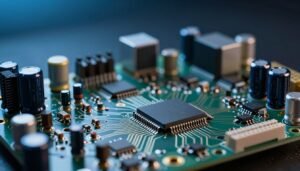
Understanding Electron Devices and Circuits Made Simple
Did you know that the average smartphone has over two billion tiny transistors? These tiny parts are key to our digital world. Yet, they often seem like magic…
FLJ PCBManufacturing your next ideaFLJ resources
Practical guides to PCB design, materials, manufacturing and assembly. Explore the details that matter before your next build.
Showing 49–60 of 112 articles
Did you know that the average smartphone has over two billion tiny transistors? These tiny parts are key to our digital world. Yet, they often seem like magic…
Modern electronic devices are becoming smaller and more powerful every day. This rapid evolution creates a significant challenge for engineers: effective heat dissipation. When components run hot, performance…
Understanding PCB Basics: Types, Materials, and How They Impact Your Project When a designer first encounters printed circuit boards, the sheer variety can feel overwhelming. At its core,…
Introduction: The High-TG PCB Strategic Imperative Your product’s reliability can depend on a single, hidden number: the Glass Transition Temperature (Tg). If this number is wrong, your board can fail. It might delaminate…
Printed circuit board design is an important factor that affects the performance of many electronic products. Making a reliable product and then winning market success is the biggest…
Short overview The main difference between reflow soldering and wave soldering is this: reflow soldering is used for boards that have surface-mount parts, while wave soldering is used…
I. Overview of PCB Layer Count Determination The total number of PCB layers is not fixed at the start. Engineers decide the layer count based on the board’s…
1. Overview Blind vias and buried vias are mainly used for high-density boards and for boards with very small holes. The goal is to save routing space and…
Ground traces and ground planes have impedance. When current flows through a ground path, a voltage will appear on that path. This voltage is noise. Noise voltage is…
Aluminum PCB Design Guide: Optimizing Heat Dissipation for Power Electronics. Power electronics generate significant heat—and when that heat isn’t properly managed, performance degrades, components fail prematurely, and entire…
The transition from PCB design to manufacturing represents the most critical juncture in electronics production—where theoretical circuit layouts either translate into reliable, cost-effective products or spiral into expensive…
Getting an accurate printed circuit board assembly quote hinges on one critical factor: the completeness of your documentation package. Manufacturing partners can’t price what they can’t see, and…