Design and manufacturing capabilities
| Base-material options | IT180, F4BM, FR4, FR1-4 and related materials |
|---|---|
| Design layer-count capability | 1–32 layers |
| Minimum line width and spacing | 3mil |
| Minimum laser-drilled hole | 4mil |
| Minimum mechanically drilled hole | 8mil |
| Copper foil thickness | 18–175 µm (standard values: 18 µm, 35 µm and 70 µm) |
| Peel strength | 1.25N/mm |
| Minimum punched-hole diameter | Single-sided: 0.9 mm / 35 mil |
| Minimum hole diameter | 0.25mm/10mil |
| Hole-diameter tolerance | For diameter ≤0.8 mm: ±0.05 mm |
| Hole-diameter tolerance | ±0.05mm |
| Plated-hole wall copper thickness | Double-sided / multilayer: ≥0.8 mil |
| Hole resistance | Double-sided / multilayer: ≤300 µΩ |
| Minimum line width | 0.127mm/5mil |
| Minimum spacing | 0.127mm/5mil |
| Surface-finish options | Rosin flux, HASL, electroplated gold, anti-oxidation treatment, immersion gold and carbon ink |
| Service | OEM services |
The role of industrial-control PCBs
An industrial-control PCB provides the circuitry that controls the normal operation of electrical equipment.
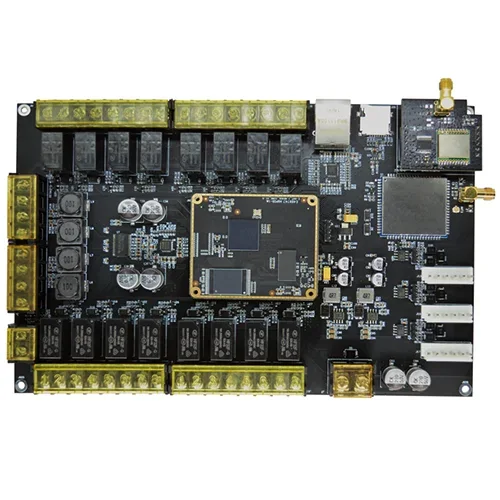
- Dedicated and general-purpose boards: an industrial-control board provides the underlying circuitry and reserved input/output connections. These ports connect to equipment such as motors, solenoid valves and sensors to implement the required functions.
- Boards for a specific function: a dedicated board is developed for a defined task. For example, a temperature-control board can connect a thermocouple to its input and a heating contactor or solid-state relay to its output, controlling the heating device. Current-control and motion-control boards are other examples.
- Programmable general-purpose control: many universal control boards can be programmed or further developed by the user. A PLC is one example: after the user writes, compiles and loads the program, it can carry out different functions through digital inputs, analog inputs, high-speed counter ports, digital outputs and analog outputs. Some boards also provide communications functions.