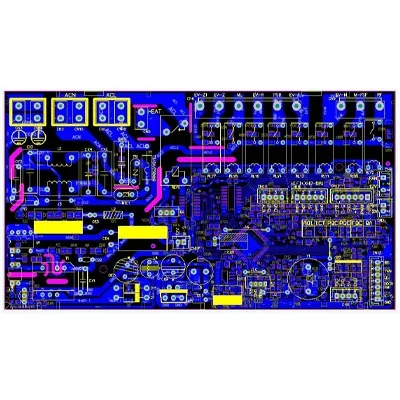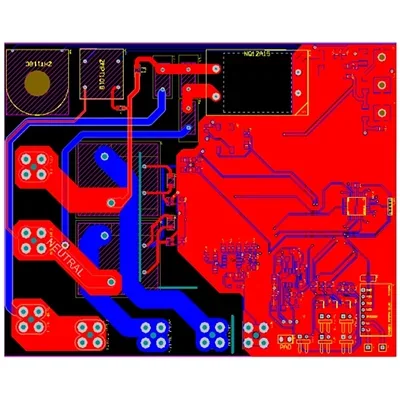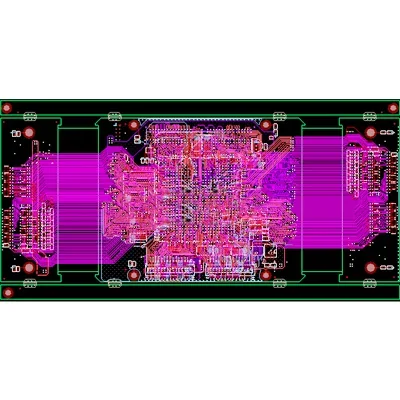
Design and manufacturing capabilities
| Design layer-count capability | 1–32 layers |
|---|---|
| Minimum line width and spacing | 3mil |
| Minimum laser-drilled hole | 4mil |
| Minimum mechanically drilled hole | 8mil |
| Copper foil thickness | 18–175 µm (standard values: 18 µm, 35 µm and 70 µm) |
| Peel strength | 1.25N/mm |
| Minimum punched-hole diameter | Single-sided: 0.9 mm / 35 mil |
| Minimum hole diameter | 0.25mm/10mil |
| Hole-diameter tolerance | For diameter ≤0.8 mm: ±0.05 mm |
| Hole-diameter tolerance | ±0.05mm |
| Plated-hole wall copper thickness | Double-sided / multilayer: ≥0.8 mil |
| Hole resistance | Double-sided / multilayer: ≤300 µΩ |
| Minimum line width | 0.127mm/5mil |
| Minimum spacing | 0.127mm/5mil |
| Legend-colour options | Black, white, red, green and other colours |
| Surface-finish options | Leaded or lead-free HASL, ENIG, silver and OSP |
| Service | OEM services |
| Quality and compliance references | ISO 9001 / RoHS / UL |
Why rigid-flex construction is used in medical equipment
Rigid-flex PCBs are used across medical-electronics applications because they combine different circuit functions in a compact format. By reducing the need for separate connectors, they can reduce connection cost and the space required for installation.
Flexible sections can fold into restricted spaces within equipment. As medical products become smaller and lighter, especially wearable and portable devices, rigid-flex construction provides a useful way to arrange the electronics.
Medical-device application areas
Defibrillators
Defibrillators apply an electrical shock to heart tissue to restore a normal heartbeat. The equipment category includes implantable defibrillators, wearable defibrillators, automated external defibrillators (AEDs) and manually operated external defibrillators used in medical facilities. Circuit boards control the electronic functions required by these systems.
Drug-delivery systems
Drug-delivery equipment provides controlled release of medication. Infusion pumps are a common example, delivering medicines such as insulin or pain relief. Accuracy and reliable operation are important circuit-design requirements.
Handheld devices
Many medical instruments, cameras and tools are handheld, making comfort during use important. Rigid-flex circuitry helps fit the electronics into the available housing space. The construction can also be selected around the sterilization requirements of equipment that undergoes autoclaving.
Portable monitoring equipment
Portable monitors measure vital signs such as blood pressure, blood oxygen saturation and body temperature. Rigid-flex PCBs help organize the electronics into smaller, portable devices while supporting their required functions.
Medical-imaging equipment
MRI systems, X-ray equipment, capsule cameras and CT scanners rely on circuit boards to operate and support the diagnosis and treatment of internal medical conditions.
Pacemakers
Pacemakers regulate the heartbeat by delivering electrical impulses. Some operate continuously, while others respond periodically when needed. Their circuit boards are essential to their electronic operation.