Why Do PCB Pads Lift? Causes, Risks, and Prevention
PCB pads lift when a copper land separates from, or is pulled away from, the laminate surface. Common contributors include excessive or repeated heating, mechanical force, weak copper-to-laminate…
 FLJ PCBManufacturing your next idea
Showing 1–12 of 45 articles
PCB pads lift when a copper land separates from, or is pulled away from, the laminate surface. Common contributors include excessive or repeated heating, mechanical force, weak copper-to-laminate…

Short answer: this 2026 editorial shortlist examines 10 of the top PCBA manufacturers in China for common procurement scenarios: Foxconn (Hon Hai), BYD Electronics, USI, Jabil, Flex, Compal,…

In high-end electronic design, a 0.4 mm pitch BGA chip, tiny 0201 resistors and capacitors, and a MEMS sensor that is very sensitive to heat are all squeezed…

With the development of communication, cloud computing, and cloud storage technologies, and the growth of higher-speed Ethernet and cloud servers, PCBs will move further toward high speed and…

What is inductance? Inductance is the numerical integration of the surface magnetic field strength. Closed magnetic flux lines form around a current. Their direction follows the right-hand rule.…
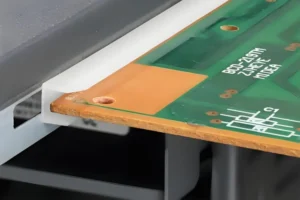
What Tg Means in PCB Engineering In a multilayer board going through lead-free reflow, laminate selection must account for the resin’s glass transition temperature (Tg). Tg describes the…

PCBA Cost: How to Estimate and Lower Your Expenses Introduction: Why Understanding PCBA Cost Is Critical for Your Project In electronics manufacturing, the line between a profitable product…

After PCBA is finished, if the finished product assembly does not happen right away, the PCBA must be stored. This prevents the PCBA from being exposed to air…

Introduction: Why Understanding PCB and PCBA Matters Every electronic device you use relies on a printed circuit board (PCB) as its physical foundation. Think of a bare PCB…

Usually, the thickness of a finished standard PCB is between 0.8 mm and 1.6 mm. The most common default board thickness is 1.6 mm (about 63 mil). Many…

With the continuous growth of the electronics industry, there are more and more types, brands, and makers of components. This also means higher demands for people who work…

What Is Reflow Soldering? Reflow soldering is one of the soldering methods used in the PCBA process. It is called reflow soldering because the solder changes from solid…